
Textbook Question
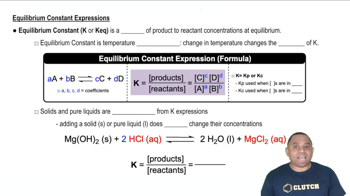
The equilibrium constant for the dissociation of molecular iodine, I2(g) ⇌ 2 I(g), at 800 K is Kc = 3.1 × 10⁻⁵. (a) Which species predominates at equilibrium I2 or I?

 Verified step by step guidance
 03:20
03:20
 07:35
07:35 01:16
01:16The equilibrium constant for the dissociation of molecular iodine, I2(g) ⇌ 2 I(g), at 800 K is Kc = 3.1 × 10⁻⁵. (a) Which species predominates at equilibrium I2 or I?
The reaction A2 + B2 ⇌ 2 AB has an equilibrium constant Kc = 1.5. The following diagrams represent reaction mixtures containing A2 molecules (red), B2 molecules (blue), and AB molecules. (a) Which reaction mixture is at equilibrium?
The equilibrium constant for the dissociation of molecular iodine, I2(g) ⇌ 2 I(g), at 800 K is Kc = 3.1×10⁻⁵. (b) Assuming both forward and reverse reactions are elementary reactions, which reaction has the larger rate constant, the forward or the reverse reaction?
When lead(IV) oxide is heated above 300°C, it decomposes according to the reaction, 2 PbO2(𝑠)⇌2PbO(𝑠)+O2(𝑔). Consider the two sealed vessels of PbO2 shown here. If both vessels are heated to 400°C and allowed to come to equilibrium, which of the following statements is or are true? c. The partial pressure of O2(𝑔) will be the same in vessels A and B. [Section 15.4]
When lead(IV) oxide is heated above 300°C, it decomposes according to the reaction, 2 PbO2(𝑠)⇌2PbO(𝑠)+O2(𝑔). Consider the two sealed vessels of PbO2 shown here. If both vessels are heated to 400°C and allowed to come to equilibrium, which of the following statements is or are true?
b. The solid left at the bottom of each vessel will be a mixture of PbO2(𝑠) and PbO(𝑠).
Suppose that the gas-phase reactions A → B and B → A are both elementary reactions with rate constants of 4.7×10⁻³ s−1 and 5.8×10⁻¹ s−1, respectively. (a) What is the value of the equilibrium constant for the equilibrium A(g) ⇌ B(g)? (b) Which is greater at equilibrium, the partial pressure of A or the partial pressure of B?