
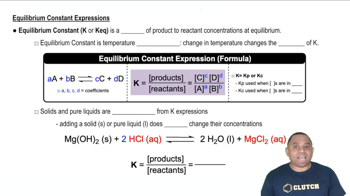
Consider the equilibrium N2(𝑔) + O2(𝑔) + Br2(𝑔) ⇌ 2 NOBr(𝑔) Calculate the equilibrium constant 𝐾𝑝 for this reaction, given the following information at 298 K:
2 NO(𝑔) + Br2(𝑔) ⇌ 2 NOBr(𝑔) 𝐾𝑐 = 2.02
NO(𝑔) ⇌ N2(𝑔) + O2(𝑔) 𝐾𝑐 = 2.1×1030

Verified step by step guidanceConsider the equilibrium N2(𝑔) + O2(𝑔) + Br2(𝑔) ⇌ 2 NOBr(𝑔) Calculate the equilibrium constant 𝐾𝑝 for this reaction, given the following information at 298 K:
2 NO(𝑔) + Br2(𝑔) ⇌ 2 NOBr(𝑔) 𝐾𝑐 = 2.02
NO(𝑔) ⇌ N2(𝑔) + O2(𝑔) 𝐾𝑐 = 2.1×1030
The following equilibria were attained at 823 K:
CoO(s) + H2(g) → Co(s) + H2O(g) Kc = 67
CoO(s) + CO(g) → Co(s) + CO2(g) Kc = 490
Based on these equilibria, calculate the value of 𝐾𝑐 for H2(𝑔)+ CO2(𝑔) ⇌ CO(𝑔) + H2O(𝑔) at 823 K.
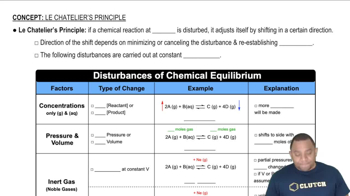
Consider the following equilibrium, for which at 𝐾𝑝 = 0.0752 at 480°C: 2 Cl2(𝑔) + 2 H2O(𝑔) ⇌ 4 HCl(𝑔) + O2(𝑔) (a) What is the value of 𝐾𝑝 for the reaction 4 HCl(𝑔) + O2(𝑔) ⇌ 2 Cl2(𝑔) + 2 H2O(𝑔)?
The equilibrium 2 NO(𝑔) + Cl2(𝑔) ⇌ 2 NOCl(𝑔) is established at 500.0 K. An equilibrium mixture of the three gases has partial pressures of 0.095 atm, 0.171 atm, and 0.28 atm for NO, Cl2, and NOCl, respectively. (a) Calculate 𝐾𝑝 for this reaction at 500.0 K.