
Textbook Question
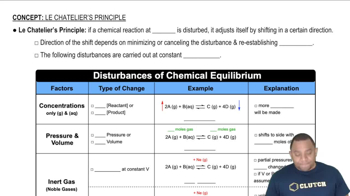
For the equilibrium Br2(𝑔) + Cl2(𝑔) ⇌ 2 BrCl(𝑔) at 400 K, 𝐾𝑐 = 7.0. If 0.25 mol of Br2 and 0.55 mol of Cl2 are introduced into a 3.0-L container at 400 K, what will be the equilibrium concentrations of Br2, Cl2, and BrCl?
1
views

 Verified step by step guidance
 07:32
07:32
 01:14
01:14 02:31
02:31For the equilibrium Br2(𝑔) + Cl2(𝑔) ⇌ 2 BrCl(𝑔) at 400 K, 𝐾𝑐 = 7.0. If 0.25 mol of Br2 and 0.55 mol of Cl2 are introduced into a 3.0-L container at 400 K, what will be the equilibrium concentrations of Br2, Cl2, and BrCl?
Consider the following equilibrium, for which Δ𝐻<0
2 SO2(𝑔) + O2(𝑔) ⇌ 2 SO3(𝑔)
(f) How will each of the following changes affect an equilibrium mixture of the three gases: SO3(𝑔) is removed from the system?
Consider the reaction 4 NH3(𝑔) + 5 O2(𝑔) ⇌ 4 NO(𝑔) + 6 H2O(𝑔), Δ𝐻 = −904.4 kJ Does each of the following increase, decrease, or leave unchanged the yield of NO at equilibrium? (d) decrease the volume of the container in which the reaction occurs
At 373 K, 𝐾𝑝 = 0.416 for the equilibrium 2 NOBr(𝑔) ⇌ 2 NO(𝑔) + Br2(𝑔) If the equilibrium partial pressures of NOBr(𝑔) and Br2(𝑔) are both 0.100 atm at 373 K, what is the equilibrium partial pressure of NO(𝑔)?
Consider the reaction 4 NH3(𝑔) + 5 O2(𝑔) ⇌ 4 NO(𝑔) + 6 H2O(𝑔), Δ𝐻 = −904.4 kJ Does each of the following increase, decrease, or leave unchanged the yield of NO at equilibrium? (a) increase [NH3] (b) increase [H2O] (c) decrease [O2]