
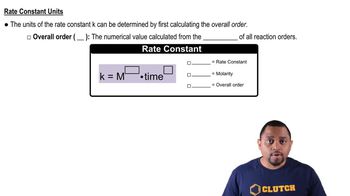
The reaction between ethyl bromide (C2H5Br) and hydroxide ion in ethyl alcohol at 330 K, C2H5Br(alc) + OH-(alc) → C2H5OH(l) + Br-(alc), is first order each in ethyl bromide and hydroxide ion. When [C2H5Br] is 0.0477 M and [OH-] is 0.100 M, the rate of disappearance of ethyl bromide is 1.7×10⁻⁷ M/s. (b) What are the units of the rate constant?

The iodide ion reacts with hypochlorite ion (the active ingredient in chlorine bleaches) in the following way: OCl - + I - ¡OI - + Cl - . This rapid reaction gives the following rate data:
[OCl4-] (M) [I-] (M) Initial Rate (M,s)
1.5 * 10-3 1.5 * 10-3
1.36 * 10-4 3.0 * 10-3 1.5 * 10-3 2.72 * 10-4
1.5 * 10-3 3.0 * 10-3 2.72 * 10-4
(b) Calculate the rate constant with proper units.
Verified step by step guidance
Verified video answer for a similar problem:
Key Concepts
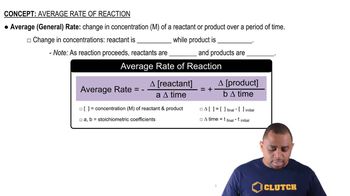
Rate of Reaction
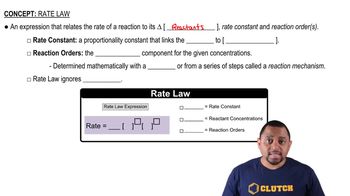
Rate Law
Units of the Rate Constant
The iodide ion reacts with hypochlorite ion (the active ingredient in chlorine bleaches) in the following way: OCl- + I- → OI- + Cl- . This rapid reaction gives the following rate data:
[OCl4-] (M) [I-] (M) Initial Rate (M,s)
1.5 * 10-3 1.5 * 10-3
1.36 * 10-4 3.0 * 10-3 1.5 * 10-3 2.72 * 10-4
1.5 * 10-3 3.0 * 10-3 2.72 * 10-4
(a) Write the rate law for this reaction.
The iodide ion reacts with hypochlorite ion (the active ingredient in chlorine bleaches) in the following way: OCl- + I- → OI- + Cl- . This rapid reaction gives the following rate data:
[OCl4-] (M) [I-] (M) Initial Rate (M,s)
1.5 * 10-3 1.5 * 10-3
1.36 * 10-4 3.0 * 10-3 1.5 * 10-3 2.72 * 10-4
1.5 * 10-3 3.0 * 10-3 2.72 * 10-4 (c) Calculate the rate when [OCl-] = 2.0 * 10-3 M and [I-] = 5.0 * 10 - 4 M.
The following data were measured for the reaction BF3(g) + NH3(g) → F3BNH3(g):
Experiment [BF3] (M) [NH3] (M) Initial Rate (M/s)
1 0.250 0.250 0.2130
2 0.250 0.125 0.1065
3 0.200 0.100 0.0682
4 0.350 0.100 0.1193
5 0.175 0.100 0.0596
(b) What is the overall order of the reaction?
The reaction between ethyl bromide (C2H5Br) and hydroxide ion in ethyl alcohol at 330 K, C2H5Br(alc) + OH-(alc) → C2H5OH(l) + Br-(alc), is first order each in ethyl bromide and hydroxide ion. When [C2H5Br] is 0.0477 M and [OH-] is 0.100 M, the rate of disappearance of ethyl bromide is 1.7×10⁻⁷ M/s. (c) How would the rate of disappearance of ethyl bromide change if the solution were diluted by adding an equal volume of pure ethyl alcohol to the solution?
