
Textbook Question
The first-order rate constant for the decomposition of N2O5, 2 N2O5(g) → 4 NO2(g) + O2(g), at 70°C is 6.82×10⁻³ s-1. Suppose we start with 0.0250 mol of N2O5(g) in a volume of 2.0 L. (c) What is the half-life of N2O5 at 70°C?

 Verified step by step guidance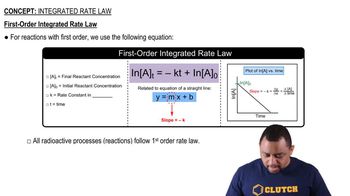
 02:29
02:29
 01:52
01:52 01:13
01:13The first-order rate constant for the decomposition of N2O5, 2 N2O5(g) → 4 NO2(g) + O2(g), at 70°C is 6.82×10⁻³ s-1. Suppose we start with 0.0250 mol of N2O5(g) in a volume of 2.0 L. (c) What is the half-life of N2O5 at 70°C?
As described in Exercise 14.41, the decomposition of sulfuryl chloride (SO2Cl2) is a first-order process. The rate constant for the decomposition at 660 K is 4.5 × 10⁻² s-1. (b) At what time will the partial pressure of SO2Cl2 decline to one-tenth its initial value?
As described in Exercise 14.41, the decomposition of sulfuryl chloride (SO2Cl2) is a first-order process. The rate constant for the decomposition at 660 K is 4.5 × 10⁻² s-1. (a) If we begin with an initial SO2Cl2 pressure of 450 torr, what is the partial pressure of this substance after 60 s?
From the following data for the first-order gas-phase isomerization of CH3NC to CH3CN at 215°C, calculate the first-order rate constant and half-life for the reaction:
Time (s) Pressure CH3NC (torr)
0 502
2000 335
5000 180
8000 95.5
12,000 41.7
15,000 22.4