
Many metallic catalysts, particularly the precious-metal ones, are often deposited as very thin films on a substance of high surface area per unit mass, such as alumina (Al2O3) or silica (SiO2). (b) How does the surface area affect the rate of reaction?
Ch.14 - Chemical Kinetics

Brown15th EditionChemistry: The Central ScienceISBN: 9780137542970Not the one you use?Change textbook
Chapter 14, Problem 80c
The addition of NO accelerates the decomposition of N2O, possibly by the following mechanism:
NO(g) + N2O(g) → N2(g) + NO2(g)
2 NO2(g) → 2 NO(g) + O2(g)
(c) If experiments show that during the decomposition of N2O, NO2 does not accumulate in measurable quantities, does this rule out the proposed mechanism?
Verified step by step guidance1
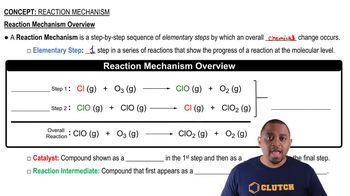
Understand the proposed mechanism: The mechanism consists of two steps. The first step is the reaction between NO and N2O to form N2 and NO2. The second step involves the decomposition of NO2 to regenerate NO and produce O2.
Consider the experimental observation: It is noted that NO2 does not accumulate in measurable quantities during the decomposition of N2O.
Analyze the implication of NO2 not accumulating: If NO2 does not accumulate, it suggests that NO2 is being consumed as quickly as it is being produced. This implies that the second step of the mechanism, where NO2 decomposes back to NO and O2, is very fast.
Evaluate the compatibility of the mechanism with the observation: The proposed mechanism can still be valid if the second step is much faster than the first step, ensuring that NO2 does not build up in the reaction mixture.
Conclude whether the mechanism is ruled out: The absence of NO2 accumulation does not necessarily rule out the proposed mechanism. It suggests that the second step is rapid, which is consistent with the mechanism as long as NO2 is consumed quickly after its formation.
Key Concepts
Here are the essential concepts you must grasp in order to answer the question correctly.
Reaction Mechanism
A reaction mechanism is a step-by-step description of the pathway by which reactants are converted into products. It includes elementary steps that detail how bonds are broken and formed. Understanding the proposed mechanism is crucial for analyzing how intermediates, like NO2, are produced and consumed during the reaction.
Recommended video:
Guided course
Reaction Mechanism Overview
Intermediates
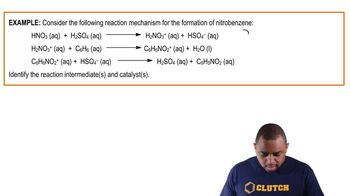
Intermediates are species that are formed during the reaction mechanism but are not present in the final products. They are typically unstable and can quickly convert to other products. In this case, the lack of measurable NO2 accumulation suggests that it may not be a stable intermediate, which is important for evaluating the validity of the proposed mechanism.
Recommended video:
Guided course
Reaction Mechanism Example
Rate of Reaction
The rate of reaction refers to the speed at which reactants are converted into products. It can be influenced by various factors, including the presence of catalysts or intermediates. If NO2 does not accumulate, it may indicate that the reaction is proceeding rapidly enough that NO2 is consumed as quickly as it is formed, which is a key consideration in assessing the proposed mechanism.
Recommended video:
Guided course
Average Rate of Reaction
Related Practice
Textbook Question
Textbook Question
The enzyme urease catalyzes the reaction of urea, (NH2CONH2), with water to produce carbon dioxide and ammonia. In water, without the enzyme, the reaction proceeds with a first-order rate constant of 4.15 × 10⁻⁵ s-1 at 100°C. In the presence of the enzyme in water, the reaction proceeds with a rate constant of 3.4 × 10⁴ s-1 at 21°C. (b) If the rate of the catalyzed reaction were the same at 100°C as it is at 21°C, what would be the difference in the activation energy between the catalyzed and uncatalyzed reactions?
Textbook Question
The addition of NO accelerates the decomposition of N2O, possibly by the following mechanism: NO1g2 + N2O1g2¡N21g2 + NO21g2 2 NO21g2¡2 NO1g2 + O21g2 (b) Is NO serving as a catalyst or an intermediate in this reaction?
