
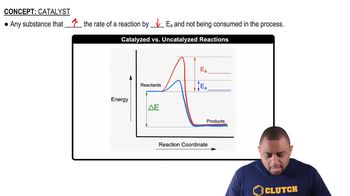
One of the many remarkable enzymes in the human body is carbonic anhydrase, which catalyzes the interconversion of carbon dioxide and water with bicarbonate ion and protons. If it were not for this enzyme, the body could not rid itself rapidly enough of the CO2 accumulated by cell metabolism. The enzyme catalyzes the dehydration (release to air) of up to 107 CO2 molecules per second. Which components of this description correspond to the terms enzyme, substrate, and turnover number?

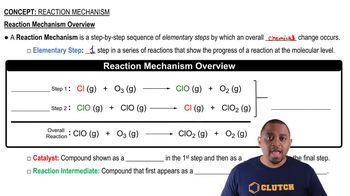
In a hydrocarbon solution, the gold compound (CH3)3AuPH3 decomposes into ethane (C2H6) and a different gold compound, (CH3)AuPH3. The following mechanism has been proposed for the decomposition of (CH3)3AuPH3:
Step 1: (CH3)3AuPH3 k1⇌k-1 (CH3)3Au + PH3 (fast)
Step 2: (CH3)3Au k2→ C2H6 + (CH3)Au (slow)
Step 3: (CH3)Au + PH3 k3→ (CH3)AuPH3 (fast)
(f) What would be the effect on the reaction rate of adding PH3 to the solution of (CH3)3AuPH3?
Verified step by step guidance
Verified video answer for a similar problem:
Key Concepts
Reaction Mechanism
Rate Law
Catalysis and Inhibition
Platinum nanoparticles of diameter 2 nm are important catalysts in carbon monoxide oxidation to carbon dioxide. Platinum crystallizes in a face-centered cubic arrangement with an edge length of 3.924 Å. (c) Using your results from (a) and (b), calculate the percentage of Pt atoms that are on the surface of a 2.0-nm nanoparticle. (d) Repeat these calculations for a 5.0-nm platinum nanoparticle.
In a hydrocarbon solution, the gold compound (CH3)3AuPH3 decomposes into ethane (C2H6) and a different gold compound, (CH3)AuPH3. The following mechanism has been proposed for the decomposition of (CH3)3AuPH3:
Step 1: (CH3)3AuPH3 k1⇌k-1 (CH3)3Au + PH3 (fast)
Step 2: (CH3)3Au k2→ C2H6 + (CH3)Au (slow)
Step 3: (CH3)Au + PH3 k3→ (CH3)AuPH3 (fast)
(c) What is the molecularity of each of the elementary steps?
Platinum nanoparticles of diameter 2 nm are important catalysts in carbon monoxide oxidation to carbon dioxide. Platinum crystallizes in a face-centered cubic arrangement with an edge length of 3.924 Å. (b) Estimate how many platinum atoms are on the surface of a 2.0-nm Pt sphere, using the surface area of a sphere (4πr2) and assuming that the 'footprint' of one Pt atom can be estimated from its atomic diameter of 2.8 A .
In a hydrocarbon solution, the gold compound (CH3)3AuPH3 decomposes into ethane (C2H6) and a different gold compound, (CH3)AuPH3. The following mechanism has been proposed for the decomposition of (CH3)3AuPH3:
Step 1: (CH3)3AuPH3 k1⇌k-1 (CH3)3Au + PH3 (fast)
Step 2: (CH3)3Au k2→ C2H6 + (CH3)Au (slow)
Step 3: (CH3)Au + PH3 k3→ (CH3)AuPH3 (fast)
(a) What is the overall reaction?
(b) What are the intermediates in the mechanism?
In a hydrocarbon solution, the gold compound (CH3)3AuPH3 decomposes into ethane (C2H6) and a different gold compound, (CH3)AuPH3. The following mechanism has been proposed for the decomposition of (CH3)3AuPH3:
Step 1: (CH3)3AuPH3 k1⇌k-1 (CH3)3Au + PH3 (fast)
Step 2: (CH3)3Au k2→ C2H6 + (CH3)Au (slow)
Step 3: (CH3)Au + PH3 k3→ (CH3)AuPH3 (fast)
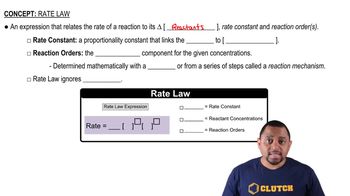
(e) What is the rate law predicted by this mechanism?
