(c) Do catalysts affect the overall enthalpy change for a reaction, the activation energy, or both?

Ch.14 - Chemical Kinetics

Brown15th EditionChemistry: The Central ScienceISBN: 9780137542970Not the one you use?Change textbook
Chapter 14, Problem 76a
(a) Most commercial heterogeneous catalysts are extremely finely divided solid materials. Why is particle size important?
Verified step by step guidance1
Understand the concept of surface area in relation to reaction rates: The rate of a chemical reaction involving a solid material can be increased by increasing the surface area of the solid.
Recognize the role of particle size: Smaller particles have a greater surface area to volume ratio compared to larger particles. This means that more of the solid material is available to interact with reactants.
Apply this to heterogeneous catalysts: In heterogeneous catalysis, the catalyst is in a different phase from the reactants. If the catalyst is a solid, maximizing its surface area allows more active sites to be available for the reactants.
Consider the practical implications: Finely divided catalysts enhance the efficiency of the catalytic process, allowing reactions to proceed faster or at lower temperatures, which can be crucial in industrial applications.
Connect to commercial use: For commercial applications, using finely divided catalysts can lead to cost efficiency and higher productivity due to the increased rate of reaction and better utilization of the catalyst.

Verified video answer for a similar problem:
This video solution was recommended by our tutors as helpful for the problem above.
Video duration:
1mWas this helpful?
Key Concepts
Here are the essential concepts you must grasp in order to answer the question correctly.
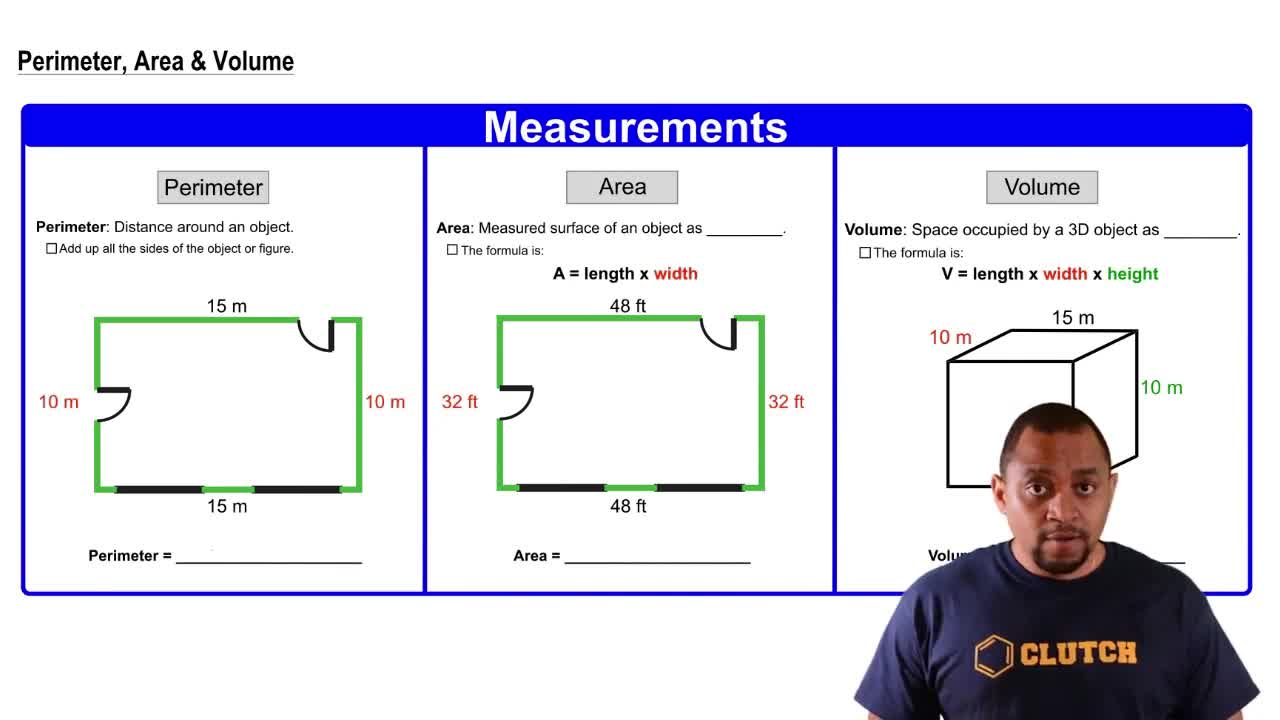
Surface Area to Volume Ratio
The surface area to volume ratio is crucial in catalysis because reactions occur at the surface of the catalyst. Smaller particles have a higher surface area relative to their volume, allowing more active sites for reactants to interact. This increased surface area enhances the catalyst's effectiveness, leading to faster reaction rates.
Recommended video:
Guided course
Perimeter, Area, Volume
Catalytic Activity
Catalytic activity refers to the ability of a catalyst to increase the rate of a chemical reaction without being consumed in the process. The particle size of a catalyst can influence its activity; smaller particles often exhibit higher activity due to more available active sites and better accessibility for reactants, which can lead to improved reaction efficiency.
Recommended video:
Guided course
Activity Series Chart
Diffusion Limitations
Diffusion limitations occur when reactants cannot reach the active sites of a catalyst quickly enough, which can hinder reaction rates. In heterogeneous catalysis, smaller particle sizes can reduce these limitations by allowing reactants to penetrate the catalyst more easily, thus facilitating faster reactions and improving overall catalytic performance.
Recommended video:
Guided course
Limiting Reagent Concept
Related Practice
Textbook Question
Textbook Question
(a) What is a catalyst? (b) What is the difference between a homogeneous and a heterogeneous catalyst?
Textbook Question
The addition of NO accelerates the decomposition of N2O, possibly by the following mechanism: NO1g2 + N2O1g2¡N21g2 + NO21g2 2 NO21g2¡2 NO1g2 + O21g2 (b) Is NO serving as a catalyst or an intermediate in this reaction?
Textbook Question
You have studied the gas-phase oxidation of HBr by O2: 4 HBr(g) + O2(g) → 2 H2O(g) + 2 Br2(g)
You find the reaction to be first order with respect to HBr and first order with respect to O2. You propose the following mechanism:
HBr(g) + O2(g) → HOOBr(g)
HOOBr(g) + HBr(g) → 2 HOBr(g)
HOBr(g) + HBr(g) → H2O(g) + Br2(g)
(b) Based on the experimentally determined rate law, which step is rate determining?