
In their study of X-ray diffraction, William and Lawrence Bragg determined that the relationship among the wavelength of the radiation 1l2, the angle at which the radiation is diffracted 1u2, and the distance between planes of atoms in the crystal that cause the diffraction (d) is given by nl = 2d sin u. X rays from a copper X-ray tube that have a wavelength of 1.54 Å are diffracted at an angle of 14.22 degrees by crystalline silicon. Using the Bragg equation, calculate the distance between the planes of atoms responsible for diffraction in this crystal, assuming n = 1 (first-order diffraction).
Ch.12 - Solids and Modern Materials

Brown15th EditionChemistry: The Central ScienceISBN: 9780137542970Not the one you use?Change textbook
Chapter 12, Problem 114c
Sodium oxide (Na2O) adopts a cubic structure with Na atoms represented by green spheres and O atoms by red spheres.

(c) The unit cell edge length is 5.550 Å. Determine the density of Na2O.
Verified step by step guidance1
Step 1: Identify the type of unit cell and the number of formula units per unit cell. For Na2O, it adopts a cubic structure, and typically, a cubic unit cell contains 4 formula units (Z = 4).
Step 2: Calculate the molar mass of Na2O. The molar mass of Na is approximately 22.99 g/mol, and the molar mass of O is approximately 16.00 g/mol. Therefore, the molar mass of Na2O is 2(22.99) + 16.00 g/mol.
Step 3: Convert the unit cell edge length from Ångströms to centimeters. The given edge length is 5.550 Å. Since 1 Å = 1 x 10^-8 cm, convert the edge length to cm.
Step 4: Calculate the volume of the unit cell. The volume of a cubic unit cell is given by the cube of the edge length (a^3).
Step 5: Determine the density of Na2O using the formula: density = (mass of unit cell) / (volume of unit cell). The mass of the unit cell can be found by multiplying the number of formula units per unit cell (Z) by the molar mass of Na2O and dividing by Avogadro's number (6.022 x 10^23).

Verified video answer for a similar problem:
This video solution was recommended by our tutors as helpful for the problem above.
Video duration:
3mWas this helpful?
Key Concepts
Here are the essential concepts you must grasp in order to answer the question correctly.
Unit Cell
A unit cell is the smallest repeating unit in a crystal lattice that reflects the overall symmetry and structure of the entire crystal. In the case of sodium oxide (Na2O), the cubic unit cell contains a specific arrangement of sodium (Na) and oxygen (O) atoms, which is crucial for calculating properties like density. Understanding the unit cell helps in visualizing how atoms are packed in a solid.
Recommended video:
Guided course
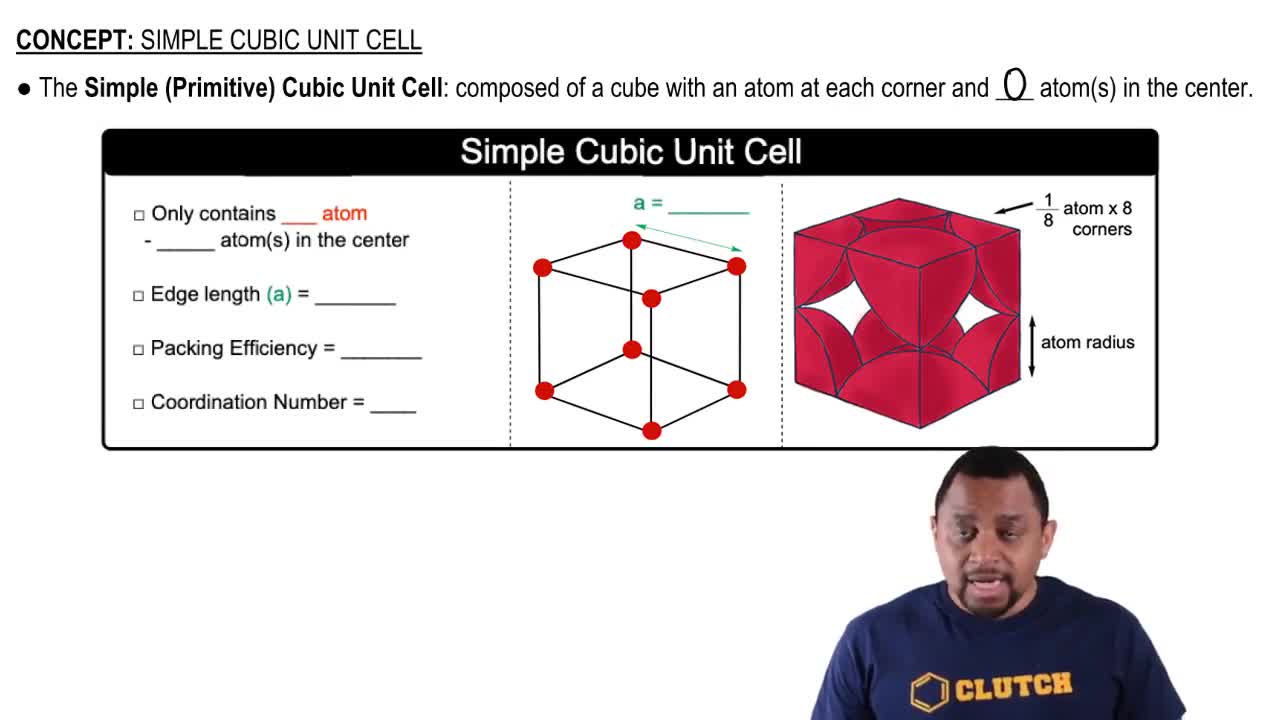
Simple Cubic Unit Cell
Density Calculation
Density is defined as mass per unit volume and is a key property of materials. To calculate the density of Na2O, one must determine the mass of the formula unit and the volume of the unit cell. The formula for density is given by ρ = mass/volume, where the mass can be derived from the molar mass of Na2O and the volume is calculated from the edge length of the cubic unit cell.
Recommended video:
Guided course
Density Concepts
Molar Mass
Molar mass is the mass of one mole of a substance, typically expressed in grams per mole (g/mol). For sodium oxide (Na2O), the molar mass is calculated by summing the atomic masses of its constituent elements: sodium (Na) and oxygen (O). This value is essential for determining the mass of the Na2O present in the unit cell, which is necessary for the density calculation.
Recommended video:
Guided course
Molar Mass Concept
Related Practice
Textbook Question
Textbook Question
Energy bands are considered continuous due to the large number of closely spaced energy levels. The range of energy levels in a crystal of copper is approximately 1×10⁻¹⁹ J. Assuming equal spacing between levels, one can approximate the spacing between energy levels by dividing the range of energies by the number of atoms in the crystal. b. Determine the average spacing in J between energy levels in the copper metal in part (a).
Textbook Question
Silicon carbide, SiC, has the three-dimensional structure shown in the figure.
(b) Would you expect the bonding in SiC to be predominantly ionic, metallic, or covalent?
