
One method to synthesize ionic solids is by the heating of two reactants at high temperatures. Consider the reaction of FeO with TiO2 to form FeTiO3. Determine the amount of each of the two reactants to prepare 2.500 g FeTiO3, assuming the reaction goes to completion. (b) Calculate the formula weight of FeTiO3.
Ch.12 - Solids and Modern Materials

Brown15th EditionChemistry: The Central ScienceISBN: 9780137542970Not the one you use?Change textbook
Chapter 12, Problem 126b
Silicon has the diamond structure with a unit cell edge length of 5.43 Å and eight atoms per unit cell. (b) Suppose you dope that 1 cm3 sample of silicon with 1 ppm of phosphorus that will increase the conductivity by a factor of a million. How many milligrams of phosphorus are required?
Verified step by step guidance1
Convert the volume of the silicon sample from cm³ to ų using the conversion factor: 1 cm = 10^8 Å.
Calculate the number of unit cells in the 1 cm³ sample by dividing the total volume in ų by the volume of one unit cell (edge length cubed).
Determine the number of silicon atoms in the sample by multiplying the number of unit cells by the number of atoms per unit cell (8 atoms).
Calculate the number of phosphorus atoms needed for 1 ppm doping by taking 1 ppm of the total number of silicon atoms.
Convert the number of phosphorus atoms to mass in milligrams using the molar mass of phosphorus (30.97 g/mol) and Avogadro's number (6.022 x 10^23 atoms/mol).

Verified video answer for a similar problem:
This video solution was recommended by our tutors as helpful for the problem above.
Video duration:
5mWas this helpful?
Key Concepts
Here are the essential concepts you must grasp in order to answer the question correctly.
Doping in Semiconductors
Doping is the intentional introduction of impurities into a semiconductor to modify its electrical properties. In silicon, adding elements like phosphorus creates free charge carriers (electrons), enhancing conductivity. The concentration of dopants is typically measured in parts per million (ppm), which indicates the amount of dopant relative to the total material.
Recommended video:
Guided course
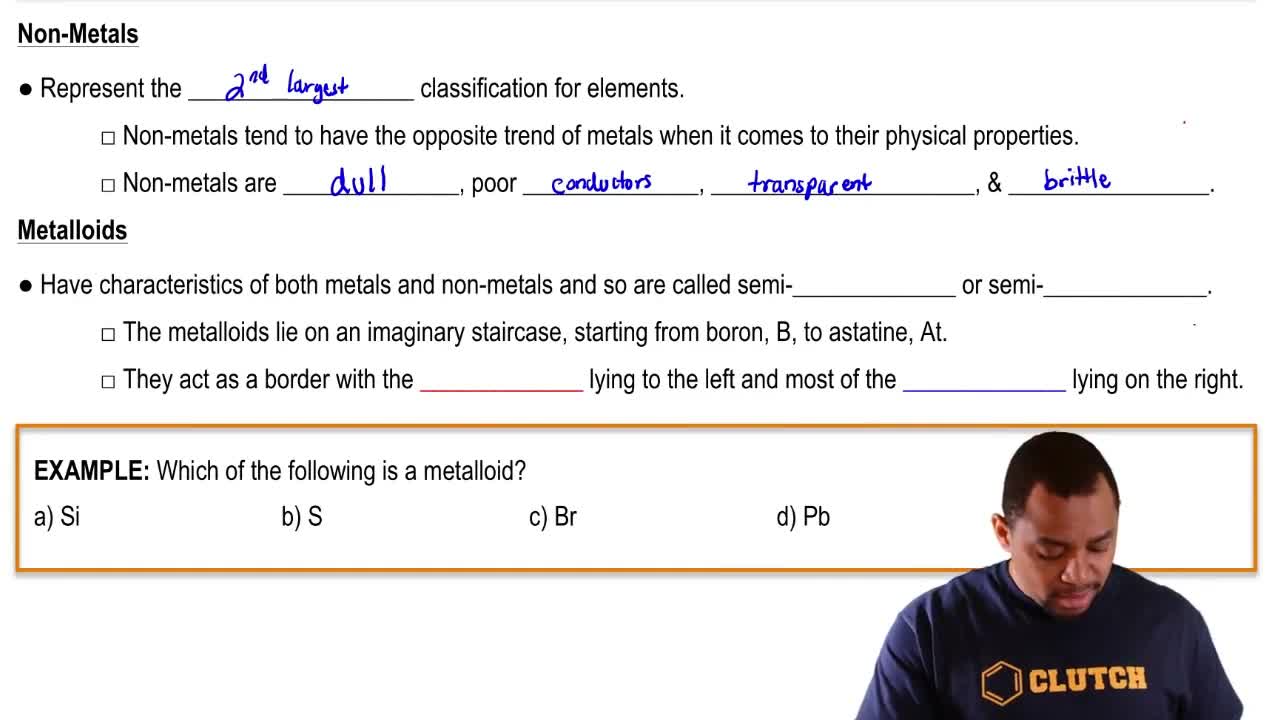
Metalloid Properties
Conductivity and its Measurement
Conductivity is a measure of a material's ability to conduct electric current, influenced by the number of charge carriers and their mobility. In semiconductors, conductivity can be significantly increased through doping. The relationship between conductivity and the concentration of charge carriers is crucial for understanding how doping affects a semiconductor's performance.
Recommended video:
Guided course
Units of Radiation Measurement
Unit Conversion and Mass Calculation
To determine the mass of phosphorus needed for doping, one must convert the concentration from ppm to a mass measurement. Since 1 ppm means 1 mg of solute per 1 L of solution, for a 1 cm³ sample, the calculation involves converting volume to liters and applying the ppm ratio to find the required mass in milligrams. This step is essential for quantifying the amount of dopant accurately.
Recommended video:
Guided course
Mass Percent Conversion
Related Practice
Textbook Question
Textbook Question
One method to synthesize ionic solids is by the heating of two reactants at high temperatures. Consider the reaction of FeO with TiO2 to form FeTiO3. Determine the amount of each of the two reactants to prepare 2.500 g FeTiO3, assuming the reaction goes to completion. (d) Determine moles and mass (g) of FeO required.
Textbook Question
(a) In polyvinyl chloride shown in Table 12.6, which bonds have the lowest average bond enthalpy?
Textbook Question
(b) When subjected to high pressure and heated, polyvinyl chloride converts to diamond. During this transformation which bonds are most likely to break first?
Textbook Question
(c) Employing the values of average bond enthalpy in Table 8.3, estimate the overall enthalpy change for converting PVC to diamond.
