
Textbook Question
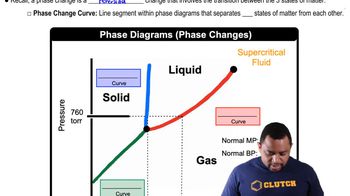
Name the phase transition in each of the following situations and indicate whether it is exothermic or endothermic: (c) Rubbing alcohol in an open container slowly disappears.

 Verified step by step guidance
 03:22
03:22
 01:23
01:23 01:59
01:59Name the phase transition in each of the following situations and indicate whether it is exothermic or endothermic: (c) Rubbing alcohol in an open container slowly disappears.
The boiling points, surface tensions, and viscosities of water and several alcohols are listed in the following table:
b. How do you explain the fact that propanol and ethylene glycol have similar molecular weights (60 vs. 62 amu), yet the viscosity of ethylene glycol is more than 10 times larger than propanol?
Ethyl chloride (C2H5Cl) boils at 12 °C. When liquid C2H5Cl under pressure is sprayed on a room-temperature (25 °C) surface in air, the surface is cooled considerably. (b) Assume that the heat lost by the surface is gained by ethyl chloride. What enthalpies must you consider if you were to calculate the final temperature of the surface?
Ethyl chloride (C2H5Cl) boils at 12 °C. When liquid C2H5Cl under pressure is sprayed on a room-temperature (25 °C) surface in air, the surface is cooled considerably. (a) What does this observation tell us about the specific heat of C2H5Cl(g) as compared with that of C2H5Cl(l)?