
Textbook Question
Complete the following table for an ideal gas:

 Verified step by step guidance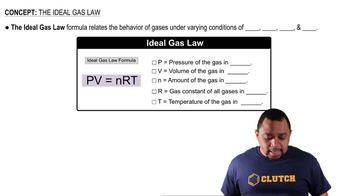
 01:15
01:15
 03:48
03:48 02:52
02:52Complete the following table for an ideal gas:
Suppose you are given two flasks at the same temperature, one of volume 2 L and the other of volume 3 L. The 2-L flask contains 4.8 g of gas, and the gas pressure is x atm. The 3-L flask contains 0.36 g of gas, and the gas pressure is 0.1x. Do the two gases have the same molar mass? If not, which contains the gas of higher molar mass?
Suppose you are given two 1-L flasks and told that one contains a gas of molar mass 30 and the other a gas of molar mass 60, both at the same temperature. The pressure in flask A is x atm, and the mass of gas in the flask is 1.2 g. The pressure in flask B is 0.5x atm, and the mass of gas in that flask is 1.2 g. Which flask contains the gas of molar mass 30, and which contains the gas of molar mass 60?
Calculate the number of molecules in a deep breath of air whose volume is 2.25 L at body temperature, 37°C, and a pressure of 735 torr.