
(b) Carbon dioxide (CO2) is a gas at room temperature and pressure. However, carbon dioxide can be put under pressure to become a 'supercritical fluid' that is a much safer dry-cleaning agent than tetrachloroethylene. At a certain pressure, the density of supercritical CO2 is 0.469 g/cm3. What is the mass of a 25.0-mL sample of supercritical CO2 at this pressure?
Ch.1 - Introduction: Matter, Energy, and Measurement

Brown15th EditionChemistry: The Central ScienceISBN: 9780137542970Not the one you use?Change textbook
Chapter 1, Problem 36a
The temperature on a warm summer day is 87 °F. What is the temperature in °C?
Verified step by step guidance1
insert step 1> Convert the given temperature from Fahrenheit to Celsius using the formula: \( T_{\text{C}} = \frac{5}{9} (T_{\text{F}} - 32) \).
insert step 2> Substitute the given Fahrenheit temperature (87 °F) into the formula: \( T_{\text{C}} = \frac{5}{9} (87 - 32) \).
insert step 3> Calculate the difference: \( 87 - 32 \).
insert step 4> Multiply the result by \( \frac{5}{9} \) to convert to Celsius.
insert step 5> The result is the temperature in degrees Celsius.

Verified video answer for a similar problem:
This video solution was recommended by our tutors as helpful for the problem above.
Video duration:
48sWas this helpful?
Key Concepts
Here are the essential concepts you must grasp in order to answer the question correctly.
Temperature Scales
Temperature can be measured using different scales, the most common being Celsius (°C) and Fahrenheit (°F). Each scale has its own zero point and degree increments, which means that a direct comparison between the two requires conversion formulas.
Recommended video:
Guided course
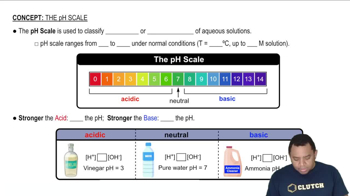
The pH Scale
Conversion Formula
To convert Fahrenheit to Celsius, the formula used is °C = (°F - 32) × 5/9. This formula accounts for the difference in the zero points and scaling between the two temperature systems, allowing for accurate conversion.
Recommended video:
Guided course
Conversion Factors
Practical Applications of Temperature Conversion
Understanding temperature conversion is essential in various fields, including science, cooking, and weather reporting. It enables effective communication of temperature-related information across different regions that may use different measurement systems.
Recommended video:
Guided course
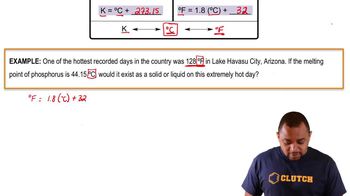
Temperature Conversion Example
Related Practice
Textbook Question
2
views
1
rank
Textbook Question
Make the following conversions: f. 0 K to °F
Textbook Question
Make the following conversions: e. 2500 °F to K
Textbook Question
Many scientific data are reported at 25 °C. What is this temperature in kelvins and in degrees Fahrenheit?
Textbook Question
Make the following conversions: d. 315 K to °F
Textbook Question
(a) A sample of tetrachloroethylene, a liquid used in dry cleaning that is being phased out because of its potential to cause cancer, has a mass of 40.55 g and a volume of 25.0 mL at 25 °C. What is its density at this temperature? Will tetrachloroethylene float on water? (Materials that are less dense than water will float.)
1
views
