(d) In March 1989, the Exxon Valdez ran aground and spilled 240,000 barrels of crude petroleum off the coast of Alaska. One barrel of petroleum is equal to 42 gal. How many liters of petroleum were spilled?
Ch.1 - Introduction: Matter, Energy, and Measurement

Brown15th EditionChemistry: The Central ScienceISBN: 9780137542970Not the one you use?Change textbook
Chapter 1, Problem 61c
(c) If an automobile is able to travel 400 km on 47.3 L of gasoline, what is the gas mileage in miles per gallon?
Verified step by step guidance1
Convert the distance from kilometers to miles using the conversion factor: 1 km = 0.621371 miles.
Convert the volume from liters to gallons using the conversion factor: 1 L = 0.264172 gallons.
Calculate the gas mileage by dividing the distance traveled in miles by the volume of gasoline used in gallons.
Set up the equation for gas mileage: \( \text{Gas Mileage} = \frac{\text{Distance in miles}}{\text{Volume in gallons}} \).
Simplify the equation to find the gas mileage in miles per gallon.

Verified video answer for a similar problem:
This video solution was recommended by our tutors as helpful for the problem above.
Video duration:
1mWas this helpful?
Key Concepts
Here are the essential concepts you must grasp in order to answer the question correctly.
Unit Conversion
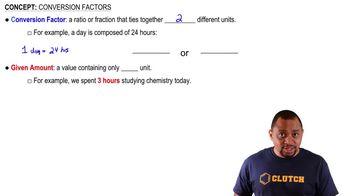
Unit conversion is the process of converting a quantity expressed in one set of units to another. In this question, it involves converting kilometers to miles and liters to gallons. Understanding the conversion factors (1 km = 0.621371 miles and 1 L = 0.264172 gallons) is essential for accurately calculating the gas mileage.
Recommended video:
Guided course
Conversion Factors
Gas Mileage Calculation
Gas mileage, often expressed in miles per gallon (mpg), measures the distance a vehicle can travel per unit of fuel consumed. To calculate it, one divides the total distance traveled by the total volume of fuel used. This concept is crucial for evaluating vehicle efficiency and environmental impact.
Recommended video:
Guided course
Gas Stoichiometry Calculation Example
Dimensional Analysis
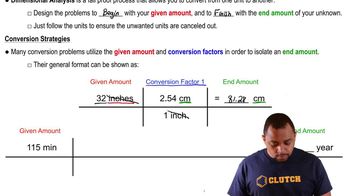
Dimensional analysis is a mathematical technique used to convert one set of units to another by using conversion factors. It ensures that the units cancel appropriately, leading to the correct final units. In this problem, dimensional analysis helps in systematically converting kilometers and liters into miles and gallons to find the desired gas mileage.
Recommended video:
Guided course
Dimensional Analysis
Related Practice
Textbook Question
4
views
Textbook Question
(b) The recommended adult dose of Elixophyllin®, a drug used to treat asthma, is 6 mg/kg of body mass. Calculate the dose in milligrams for a 185-lb person.
2
views
Textbook Question
(a) How many liters of wine can be held in a wine barrel whose capacity is 31 gal?
1
views
Textbook Question
Carry out the following conversions: (e) \$3.99/lb to dollars per kg
1
views
Textbook Question
(d) When the coffee is brewed according to directions, a pound of coffee beans yields 50 cups of coffee (4 cups = 1 qt). How many kg of coffee are required to produce 200 cups of coffee?
1
views
Textbook Question
(a) If an electric car is capable of going 225 km on a single charge, how many charges will it need to travel from Seattle, Washington, to San Diego, California, a distance of 1257 mi, assuming that the trip begins with a full charge?
1
views