Ch.6 - Electronic Structure of Atoms
Brown - Chemistry: The Central Science 14th Edition
Brown14th EditionChemistry: The Central ScienceISBN: 9780134414232Not the one you use?Change textbook
Chapter 6, Problem 64

Sketch the shape and orientation of the following types of orbitals: (a) px, (b) dz2, (c) dx2 - y2.

Verified step by step guidance
1
Understand that the d orbitals are a set of five orbitals in the third energy level and higher, each with a unique shape and orientation.
Recognize that the \(d_{x^2 - y^2}\) orbital is one of these five d orbitals, characterized by its distinct shape.
Visualize the \(d_{x^2 - y^2}\) orbital as having four lobes oriented along the x and y axes, forming a cloverleaf shape.
Note that the lobes of the \(d_{x^2 - y^2}\) orbital lie in the xy-plane, with the nodal planes along the x = 0 and y = 0 lines, meaning there is no electron density along these lines.
Remember that the orientation of the \(d_{x^2 - y^2}\) orbital is crucial for understanding its role in chemical bonding, particularly in transition metal complexes.

Verified video answer for a similar problem:

This video solution was recommended by our tutors as helpful for the problem above.
Video duration:
5m

Key Concepts

Here are the essential concepts you must grasp in order to answer the question correctly.

Atomic Orbitals

Atomic orbitals are regions in an atom where there is a high probability of finding electrons. They are defined by quantum numbers and have distinct shapes, such as s, p, d, and f orbitals. Each type of orbital has a specific geometric configuration that influences the chemical properties of the atom.
Recommended video:
Guided course
01:51
Atomic Orbitals Example

d-Orbitals

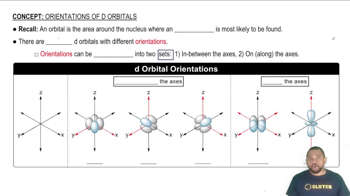
d-orbitals are a set of five orbitals that are more complex in shape compared to s and p orbitals. They are important for transition metals and can hold a maximum of ten electrons. The dx2 - y2 orbital, in particular, has a unique shape that resembles a four-leaf clover, oriented along the x and y axes.
Recommended video:
Guided course
02:06
d Orbital Orientations

Orbital Orientation

Orbital orientation refers to the spatial arrangement of orbitals in relation to the axes of a coordinate system. For the dx2 - y2 orbital, its lobes are oriented along the x and y axes, with nodal planes along the diagonals. Understanding this orientation is crucial for predicting molecular geometry and bonding behavior in chemistry.
Recommended video:
Guided course
02:06
d Orbital Orientations