Alcohol-based fuels for automobiles lead to the production of formaldehyde (CH2O) in exhaust gases. Formaldehyde undergoes photodissociation, which contributes to photo- chemical smog: CH2O + hn ¡ CHO + H The maximum wavelength of light that can cause this reac- tion is 335 nm. (d) Write out the formaldehyde photodis- sociation reaction, showing Lewis-dot structures.
Ch.18 - Chemistry of the Environment
Brown14th EditionChemistry: The Central ScienceISBN: 9780134414232Not the one you use?Change textbook
Chapter 18, Problem 33b
Alcohol-based fuels for automobiles lead to the production of formaldehyde (CH2O) in exhaust gases. Formaldehyde undergoes photodissociation, which contributes to photo- chemical smog: CH2O + hn ¡ CHO + H The maximum wavelength of light that can cause this reaction is 335 nm. (b) What is the maximum strength of a bond, in kJ/mol, that can be broken by absorption of a photon of 335-nm light?
Verified step by step guidance1
Step 1: First, we need to calculate the energy of a photon of light with a wavelength of 335 nm. We can use the equation E = hc/λ, where E is the energy, h is Planck's constant (6.626 x 10^-34 J*s), c is the speed of light (3.00 x 10^8 m/s), and λ is the wavelength in meters. Remember to convert the wavelength from nm to m by multiplying by 1 x 10^-9.
Step 2: The energy obtained in step 1 will be in Joules. However, the question asks for the energy in kJ/mol. To convert the energy from Joules to kJ/mol, we need to use Avogadro's number (6.022 x 10^23 mol^-1). Multiply the energy obtained in step 1 by Avogadro's number and divide by 1000 to convert from Joules to kJ.
Step 3: The energy calculated in step 2 is the maximum energy that can be absorbed by a molecule of formaldehyde to break a bond. This energy corresponds to the maximum strength of a bond that can be broken by absorption of a photon of 335-nm light.

Verified video answer for a similar problem:
This video solution was recommended by our tutors as helpful for the problem above.
Video duration:
6mWas this helpful?
Key Concepts
Here are the essential concepts you must grasp in order to answer the question correctly.
Photon Energy
The energy of a photon is directly related to its wavelength, described by the equation E = hc/λ, where E is energy, h is Planck's constant, c is the speed of light, and λ is the wavelength. For a photon with a wavelength of 335 nm, this relationship allows us to calculate the energy absorbed when the photon is absorbed by a molecule, which can lead to bond dissociation.
Recommended video:
Guided course
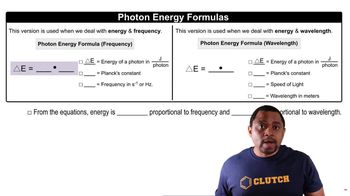
Photon Energy Formulas
Bond Dissociation Energy
Bond dissociation energy is the amount of energy required to break a specific bond in a molecule, resulting in the formation of separate atoms or radicals. It is typically expressed in kJ/mol and is a critical factor in understanding how much energy is needed to initiate chemical reactions, such as the photodissociation of formaldehyde.
Recommended video:
Guided course
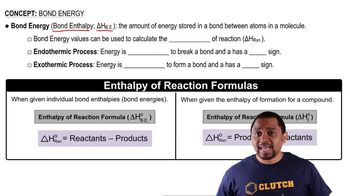
Bond Energy
Photodissociation
Photodissociation is the process by which a chemical bond is broken due to the absorption of light, resulting in the formation of reactive species. In the context of formaldehyde, the absorption of a photon can provide enough energy to break the C-H bond, leading to the production of carbonyl (CHO) and hydrogen (H) radicals, which are significant in atmospheric chemistry and smog formation.
Related Practice
Textbook Question
Textbook Question
(b) If a limestone sculpture were treated to form a surface layer of calcium sulfate, would this help to slow down the effects of acid rain? Explain.
Textbook Question
An important reaction in the formation of photochemical smog is the photodissociation of NO : NO2 + hv → NO(g) + O(g) The maximum wavelength of light that can cause this reac- tion is 420 nm. (a) In what part of the electromagnetic spec- trum is light with this wavelength found?
2
views
Textbook Question
An important reaction in the formation of photochemical smog is the photodissociation of NO : NO2 + hv → NO(g) + O(g) The maximum wavelength of light that can cause this reaction is 420 nm. (b) What is the maximum strength of a bond, in kJ/mol, that can be broken by absorption of a photon of 420-nm light?
