Give the approximate values for the indicated bond angles in the following molecules: (d)

Ch.9 - Molecular Geometry and Bonding Theories
Brown14th EditionChemistry: The Central ScienceISBN: 9780134414232Not the one you use?Change textbook
Chapter 9, Problem 30a
Give the approximate values for the indicated bond angles in the following molecules: (a)
Verified step by step guidance1
Identify the central atom in the molecule.
Determine the electron domain geometry around the central atom using the VSEPR theory, which considers both bonding and non-bonding electron pairs.
Count the number of bonding pairs and lone pairs around the central atom to predict the molecular geometry.
Use the molecular geometry to estimate the bond angles. For example, tetrahedral geometries have bond angles of about 109.5°, trigonal planar geometries have bond angles of about 120°, and linear geometries have bond angles of about 180°.
Consider any deviations from ideal bond angles due to factors such as lone pairs or double bonds, which can slightly alter the angles.

Verified video answer for a similar problem:
This video solution was recommended by our tutors as helpful for the problem above.
Video duration:
2mWas this helpful?
Key Concepts
Here are the essential concepts you must grasp in order to answer the question correctly.
Bond Angles
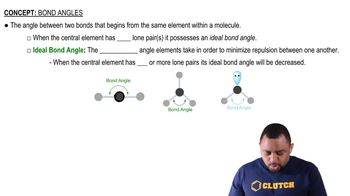
Bond angles are the angles formed between two adjacent bonds at a central atom in a molecule. They are crucial for understanding molecular geometry and are influenced by the arrangement of electron pairs around the central atom, which can be predicted using VSEPR (Valence Shell Electron Pair Repulsion) theory.
Recommended video:
Guided course
Bond Angles
VSEPR Theory
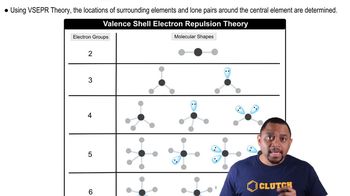
VSEPR theory is a model used to predict the geometry of individual molecules based on the repulsion between electron pairs surrounding a central atom. According to this theory, electron pairs will arrange themselves to minimize repulsion, leading to specific bond angles characteristic of different molecular shapes, such as linear, trigonal planar, or tetrahedral.
Recommended video:
Guided course
Molecular Shapes and VSEPR
Molecular Geometry
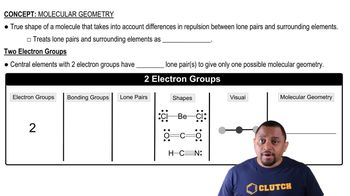
Molecular geometry refers to the three-dimensional arrangement of atoms within a molecule. It is determined by the number of bonding and non-bonding electron pairs around the central atom, which influences the bond angles. Common geometries include linear (180°), trigonal planar (120°), and tetrahedral (109.5°), each with distinct bond angles.
Recommended video:
Guided course
Molecular Geometry with Two Electron Groups
Related Practice
Textbook Question
Textbook Question
Ammonia, NH3, reacts with incredibly strong bases to produce the amide ion, NH2-. Ammonia can also react with acids to produce the ammonium ion, NH4+. (a) Which species (amide ion, ammonia, or ammonium ion) has the largest H¬N¬H bond angle? (b) Which species has the smallest H¬N¬H bond angle?
Textbook Question
Give the approximate values for the indicated bond angles in the following molecules: (c)
Textbook Question
The figure that follows contains ball-and-stick drawings of three possible shapes of an AF4 molecule. (c) Which of the following elements will lead to an AF4 molecule with the shape in (iii): Be, C, S, Se, Si, Xe? i.
ii.
iii.
1
views
Textbook Question
Give the approximate values for the indicated bond angles in the following molecules: (a)