
Textbook Question
For each statement, indicate whether it is true or false. (d) Nonbonding electron pairs cannot occupy a hybrid orbital.
 Verified step by step guidance
 02:03
02:03
 03:06
03:06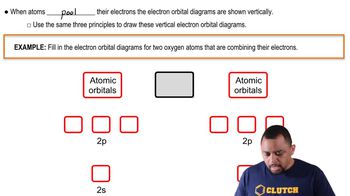 01:51
01:51For each statement, indicate whether it is true or false. (d) Nonbonding electron pairs cannot occupy a hybrid orbital.
Draw sketches illustrating the overlap between the following orbitals on two atoms: (a) the 2s orbital on each atom
Dichloroethylene (C2H2Cl2) has three forms (isomers), each of which is a different substance. (b) Which of these isomers has a zero dipole moment?
Draw sketches illustrating the overlap between the following orbitals on two atoms: (b) the 2pz orbital on each atom (assume both atoms are on the z-axis) (c) the 2s orbital on one atom and the 2pz orbital on the other atom.
Dihydroxybenzene, C6H6O2, exists in three forms (isomers) called ortho, meta, and para:
Which of these has a nonzero dipole moment?
Dichloroethylene (C2H2Cl2) has three forms (isomers), each of which is a different substance. (c) How many isomeric forms can chloroethylene, C2H3Cl, have? Would they be expected to have dipole moments?