Using Lewis symbols and Lewis structures, make a sketch of the formation of NCl3 from N and Cl atoms, showing valence-shell electrons. (a) How many valence electrons does N have initially? (c) How many valence electrons surround the N in the NCl3 molecule? (d) How many valence electrons surround each Cl in the NCl3 molecule?
Which of these elements are unlikely to form ionic bonds: Mg, Al, Si, Br, I?
Verified step by step guidanceKey Concepts
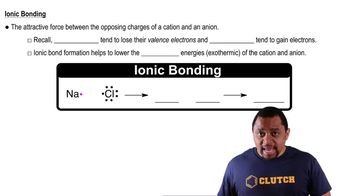
Ionic Bonds
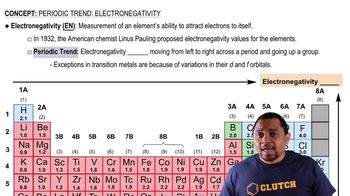
Electronegativity
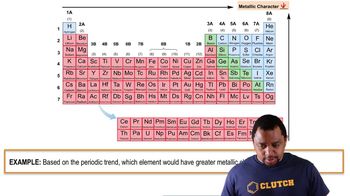
Metallic vs. Nonmetallic Character
(a) State whether or not the bonding in each substance is likely to be covalent: (i) glucose, (ii) nitrogen, (iii) aluminum hydroxide, (iv) ammonia, (v) neon.
Using Lewis symbols and Lewis structures, make a sketch of the formation of NCl3 from N and Cl atoms, showing valence-shell electrons. (b) How many bonds Cl has to make in order to achieve an octet?
Using Lewis symbols and Lewis structures, make a sketch of the formation of NCl3 from N and Cl atoms, showing valence-shell electrons. (e) How many lone pairs of electrons are in the NCl3 molecule?
(b) Using data from Appendix C, Figure 7.11, Figure 7.13, and the value of the second ionization energy for Ca, 1145 kJ/mol, calculate the lattice energy of CaCl2.
(b) A substance, XY, formed from two different elements, melts at −33 °C. Is XY likely to be a covalent or an ionic substance?
