
Textbook Question
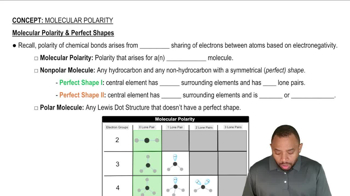
Consider the collection of nonmetallic elements O, P, Te, I, and B. (a) Which two would form the most polar single bond?
 Verified step by step guidance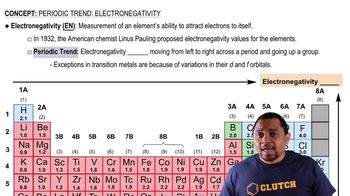
 02:10
02:10
 02:38
02:38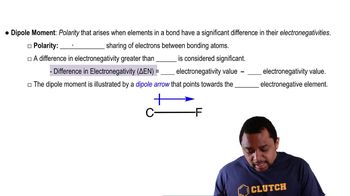 01:25
01:25Consider the collection of nonmetallic elements O, P, Te, I, and B. (a) Which two would form the most polar single bond?
Construct a Born–Haber cycle for the formation of the hypothetical compound NaCl2, where the sodium ion has a 2+ charge (the second ionization energy for sodium is given in Table 7.2). (a) How large would the lattice energy need to be for the formation of NaCl2 to be exothermic?
Consider the collection of nonmetallic elements: B, As, O, and I. (d) Which element would likely to participate in two covalent bonds?
The ionic compound CaO crystallizes with the same structure as sodium chloride (Figure 8.3). (a) In this structure, how many O2- are in contact with each Ca2+ ion (Hint: Remember the pattern of ions shown in Figure 8.3 repeats over and over again in all three directions.)
Consider the collection of nonmetallic elements O, P, Te, I, and B. (b) Which two would form the longest single bond?