
Textbook Question
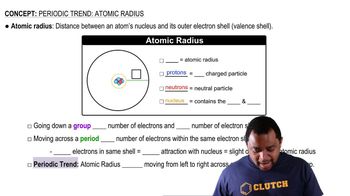
Consider S, Cl, and K and their most common ions. (b) List the ions in order of increasing size. (c) Explain any differences in the orders of the atomic and ionic sizes.
 Verified step by step guidance
 02:02
02:02
 00:50
00:50 00:38
00:38Consider S, Cl, and K and their most common ions. (b) List the ions in order of increasing size. (c) Explain any differences in the orders of the atomic and ionic sizes.
Consider the isoelectronic ions F- and Na+. (c) Repeat this calculation using Slater’s rules to estimate the screening constant, S.
Provide a brief explanation for each of the following: (a) Cl- is larger than Ar. (b) P3- is larger than S2-. (c) K+ is larger than Na+. (d) F- is larger than F.
Consider the isoelectronic ions F- and Na+. (d) For isoelectronic ions, how are effective nuclear charge and ionic radius related?