
Textbook Question
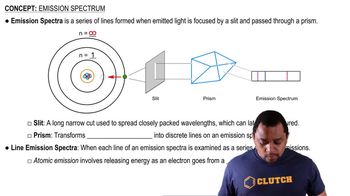
Is energy emitted or absorbed when the following electronic transitions occur in hydrogen? (a) from n = 3 to n = 2 (c) an electron adds to the H+ ion and ends up in the n = 2 shell?
 Verified step by step guidance
 01:22
01:22
 01:51
01:51 01:40
01:40Is energy emitted or absorbed when the following electronic transitions occur in hydrogen? (a) from n = 3 to n = 2 (c) an electron adds to the H+ ion and ends up in the n = 2 shell?
Classify each of the following statements as either true or false: (a) A hydrogen atom in the n = 3 state can emit light at only two specific wavelengths (b) a hydrogen atom in the n = 2 state is at a lower energy than one in the n = 1 state (c) the energy of an emitted photon equals the energy difference of the two states involved in the emission.
(b) Is this line in the visible region of the electromagnetic spectrum?
(a) Using Equation 6.5, calculate the energy of an electron in the hydrogen atom when n = 3 and when n = 6. Calculate the wavelength of the radiation released when an electron moves from n = 6 to n = 3.
Consider a transition of the electron in the hydrogen atom from n = 8 to n = 3. (b) Will the light be absorbed or emitted?
Is energy emitted or absorbed when the following electronic transitions occur in hydrogen? (b) from an orbit of radius 0.846 nm to one of radius 0.212 nm