
Textbook Question
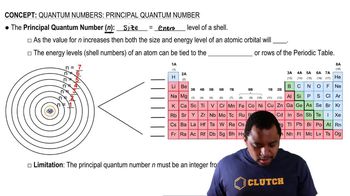
(a) For n = 4, what are the possible values of l?

 Verified step by step guidance
 02:55
02:55 02:55
02:55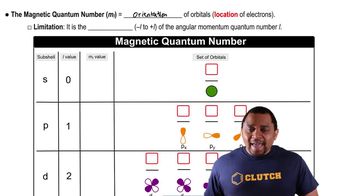 03:06
03:06(a) For n = 4, what are the possible values of l?
Using Heisenberg's uncertainty principle, calculate the uncertainty in the position of (b) a proton moving at a speed of 15.00 { 0.012 * 104 m/s. (The mass of a proton is given in the table of fundamental constants in the inside cover of the text.)
Calculate the uncertainty in the position of (a) an electron moving at a speed of 13.00 ± 0.012 × 10⁵ m/s (b) a neutron moving at this same speed. (The masses of an electron and a neutron are given in the table of fundamental constants in the inside cover of the text.)
Give the numerical values of n and l corresponding to each of the following orbital designations: (a) 3p (b) 2s (c) 4f
Give the numerical values of n and l corresponding to each of the following orbital designations: (d) 5d.
Give the values for n, l, and ml for (a) each orbital in the 3p subshell, (b) each orbital in the 4f subshell.