If human height were quantized in 1-cm increments, what would happen to the height of a child as she grows up: (i) the child's height would never change, (ii) the child's height would continuously increase, (iii) the child's height would increase in jumps of 6 cm, or (iv) the child's height would increase in 'jumps' of 1 cm at a time?
Ch.6 - Electronic Structure of Atoms
Brown14th EditionChemistry: The Central ScienceISBN: 9780134414232Not the one you use?Change textbook
Chapter 6, Problem 24
Einstein's 1905 paper on the photoelectric effect was thefirst important application of Planck's quantum hypothesis.Describe Planck's original hypothesis, and explain howEinstein made use of it in his theory of the photoelectriceffect.
Verified step by step guidance1
Planck's original hypothesis proposed that energy is quantized and can be emitted or absorbed in discrete units called 'quanta' or 'photons'. The energy of each quantum is proportional to the frequency of the radiation, expressed as E = h\(\nu\), where E is energy, h is Planck's constant, and \(\nu\) is the frequency.
Einstein applied Planck's quantum hypothesis to explain the photoelectric effect, which is the emission of electrons from a material when it is exposed to light.
Einstein proposed that light consists of particles, or photons, each with energy E = h\(\nu\). When a photon strikes an electron in a material, it transfers its energy to the electron.
If the energy transferred from the photon to the electron is greater than the work function (the minimum energy needed to remove an electron from the material), the electron is ejected from the material.
Einstein's theory explained why the photoelectric effect depends on the frequency of light, not its intensity, and provided evidence for the particle nature of light, supporting the concept of quantization introduced by Planck.

Verified video answer for a similar problem:
This video solution was recommended by our tutors as helpful for the problem above.
Video duration:
2mWas this helpful?
Key Concepts
Here are the essential concepts you must grasp in order to answer the question correctly.
Planck's Quantum Hypothesis
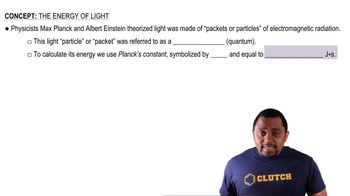
Max Planck proposed that energy is quantized, meaning it can only be emitted or absorbed in discrete units called 'quanta' or 'photons.' This hypothesis was revolutionary as it challenged classical physics, which treated energy as a continuous quantity. Planck's work laid the foundation for quantum mechanics, suggesting that the energy of electromagnetic radiation is proportional to its frequency.
Recommended video:
Guided course
Photons and Planck's Constant
Photoelectric Effect
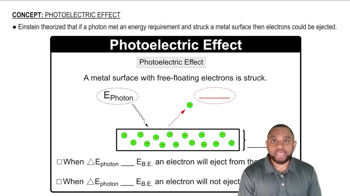
The photoelectric effect refers to the phenomenon where electrons are emitted from a material, typically a metal, when it is exposed to light of sufficient frequency. Classical wave theory could not explain why light below a certain frequency failed to eject electrons, regardless of its intensity. Einstein's explanation of this effect demonstrated that light behaves as both a wave and a particle, supporting Planck's quantum hypothesis.
Recommended video:
Guided course
Photoelectric Effect
Energy-Frequency Relationship
Einstein built on Planck's hypothesis by establishing a direct relationship between the energy of a photon and its frequency, expressed by the equation E = hf, where E is energy, h is Planck's constant, and f is frequency. This relationship explains why only light above a certain frequency can cause the photoelectric effect, as the energy of the photons must be sufficient to overcome the work function of the material to release electrons.
Recommended video:
Guided course
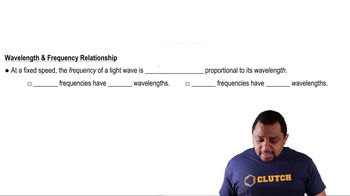
Frequency-Wavelength Relationship
Related Practice
Textbook Question
1
views
Textbook Question
(a) Calculate the energy of a photon of electromagnetic radiation whose frequency is 2.94 × 10¹⁴ s-1.
1
views
Textbook Question
(b) Calculate the energy of a photon of radiation whose wavelength is 413 nm.
1
views
Textbook Question
A laser pointer used in a lecture hall emits light at 650 nm. Using Figure 6.4, predict the color associated with this wavelength.
2
views
Textbook Question
(c) What wavelength of radiation has photons of energy 6.06 × 10⁻¹⁹ J?
Textbook Question
It is possible to convert radiant energy into electrical energy using photovoltaic cells. Assuming equal efficiency of conversion, would infrared or ultraviolet radiation yield more electrical energy on a per-photon basis?
2
views
