Determine whether each of the following sets of quantum numbers for the hydrogen atom are valid. If a set is not valid, indicate which of the quantum numbers has a value that is not valid: (a) n = 3, l = 3, ml = 2, ms = +1/2 (b) n = 4, l = 3, ml = -3, ms = +1/2 (c) n = 3, l = 1, ml = 2, ms = +1/2 (d) n = 5, l = 0, ml = 0, ms = 0 (e) n = 2, l = 1, ml = 1, ms = -1/2
Ch.6 - Electronic Structure of Atoms
Brown14th EditionChemistry: The Central ScienceISBN: 9780134414232Not the one you use?Change textbook
Chapter 6, Problem 94
Bohr’s model can be used for hydrogen-like ions—ions that have only one electron, such as He+ and Li2+. The ground-state energies of B4+, C5+, and N6+ are tabulated as follows: Atom or ion B4+ C5+ N6+ Ground-state energy -5.45 * 10^-17 J -7.85 * 10^-17 J -1.07 * 10^-16 J. By examining these numbers, propose a relationship between the ground-state energy of hydrogen-like systems and the nuclear charge, Z. (Hint: Divide by the ground-state energy of hydrogen, -2.18 * 10^-18 J)
Verified step by step guidance1
Identify the given ground-state energies for the ions B4+, C5+, and N6+ as -5.45 * 10^-17 J, -7.85 * 10^-17 J, and -1.07 * 10^-16 J, respectively.
Recognize that the ground-state energy of hydrogen is given as -2.18 * 10^-18 J. This will be used as a reference to compare the energies of the hydrogen-like ions.
For each ion, calculate the ratio of its ground-state energy to the ground-state energy of hydrogen. This can be expressed as: \( \text{Ratio} = \frac{E_{\text{ion}}}{E_{\text{hydrogen}}} \), where \( E_{\text{ion}} \) is the ground-state energy of the ion and \( E_{\text{hydrogen}} \) is the ground-state energy of hydrogen.
Recognize that the nuclear charge, Z, for each ion corresponds to the atomic number of the element. For B4+, Z = 5; for C5+, Z = 6; and for N6+, Z = 7.
Propose a relationship by observing the pattern in the calculated ratios and the corresponding nuclear charges. Consider that the ground-state energy is proportional to the square of the nuclear charge, Z, in hydrogen-like systems. This can be expressed as: \( E \propto Z^2 \).
Key Concepts
Here are the essential concepts you must grasp in order to answer the question correctly.
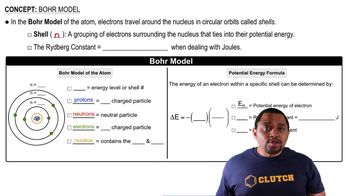
Bohr's Model
Bohr's model describes the behavior of electrons in hydrogen-like atoms, where electrons orbit the nucleus in defined paths or energy levels. The model quantizes angular momentum and provides a formula for calculating the energy levels based on the atomic number (Z) and the principal quantum number (n). This model is particularly useful for understanding one-electron systems, such as hydrogen and its ions.
Recommended video:
Guided course
Bohr Model of the Atom
Ground-State Energy
Ground-state energy refers to the lowest energy state of an electron in an atom or ion. In hydrogen-like ions, this energy is influenced by the nuclear charge (Z), which increases the attraction between the nucleus and the electron, resulting in more negative energy values. The more protons in the nucleus, the lower (more negative) the ground-state energy becomes, indicating a stronger binding of the electron.
Recommended video:
Guided course
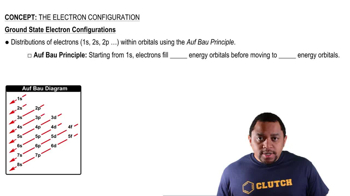
Ground State Electron Configurations
Nuclear Charge (Z)
Nuclear charge, denoted as Z, is the total charge of the nucleus due to protons. In hydrogen-like ions, Z directly affects the energy levels of the electron; as Z increases, the ground-state energy becomes more negative. This relationship can be quantitatively analyzed by comparing the ground-state energies of different ions to that of hydrogen, revealing how the energy scales with the square of the nuclear charge.
Recommended video:
Guided course
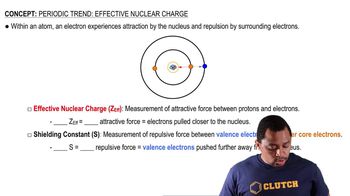
Effective Nuclear Charge
Related Practice
Textbook Question
Textbook Question
Bohr's model can be used for hydrogen-like ions—ions that have only one electron, such as He+ and Li2+. (a) Why is the Bohr model applicable to He+ ions but not to neutral He atoms?
Textbook Question
The series of emission lines of the hydrogen atom for which nf = 3 is called the Paschen series. (b) Calculate the wavelengths of the first three lines in the Paschen series—those for which ni = 4, 5, and 6.
9
views
Textbook Question
The series of emission lines of the hydrogen atom for which nf = 3 is called the Paschen series. (a) Determine the region of the electromagnetic spectrum in which the lines of the Paschen series are observed.
1
views
