One type of sunburn occurs on exposure to UV light of wavelength in the vicinity of 325 nm. (a) What is the energy of a photon of this wavelength?
Ch.6 - Electronic Structure of Atoms
Brown14th EditionChemistry: The Central ScienceISBN: 9780134414232Not the one you use?Change textbook
Chapter 6, Problem 28
An AM radio station broadcasts at 1000 kHz and its FM partner broadcasts at 100 MHz. Calculate and compare the energy of the photons emitted by these two radio stations.
Verified step by step guidance1
Convert the frequencies of both the AM and FM radio stations from MHz and kHz to Hz. Remember that 1 MHz = 1,000,000 Hz and 1 kHz = 1,000 Hz.
Use the formula for the energy of a photon, E = h \(\cdot\) f, where E is the energy, h is Planck's constant (approximately 6.626 x 10^{-34} Joule seconds), and f is the frequency in Hz.
Substitute the frequency of the AM radio station into the formula and calculate the energy of a photon emitted by the AM station.
Substitute the frequency of the FM radio station into the formula and calculate the energy of a photon emitted by the FM station.
Compare the energies of the photons emitted by the AM and FM stations to understand the difference in energy based on the frequency of the radio waves.

Verified video answer for a similar problem:
This video solution was recommended by our tutors as helpful for the problem above.
Video duration:
2mWas this helpful?
Key Concepts
Here are the essential concepts you must grasp in order to answer the question correctly.
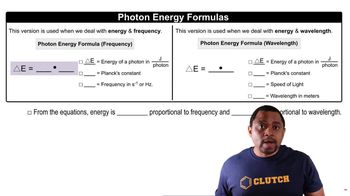
Photon Energy
Photon energy is directly related to its frequency and can be calculated using the equation E = hν, where E is energy, h is Planck's constant (6.626 x 10^-34 J·s), and ν is the frequency in hertz. Higher frequency photons carry more energy, which is crucial for comparing the energy emitted by different radio stations.
Recommended video:
Guided course
Photon Energy Formulas
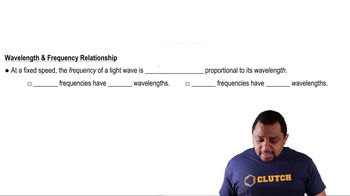
Frequency and Wavelength
Frequency is the number of cycles of a wave that pass a point in one second, measured in hertz (Hz). In radio waves, frequency and wavelength are inversely related; as frequency increases, wavelength decreases. This relationship is important for understanding how different radio stations operate at varying frequencies.
Recommended video:
Guided course
Frequency-Wavelength Relationship
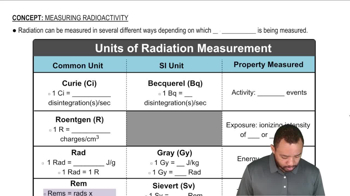
Units of Measurement
In this context, frequencies are given in kilohertz (kHz) and megahertz (MHz), where 1 MHz equals 1000 kHz. Understanding these units is essential for accurately calculating and comparing the energies of the photons emitted by the AM and FM radio stations, ensuring proper conversions are applied.
Recommended video:
Guided course
Units of Radiation Measurement
Related Practice
Textbook Question
Textbook Question
One type of sunburn occurs on exposure to UV light of wavelength in the vicinity of 325 nm. (b) What is the energy of a mole of these photons?
Textbook Question
One type of sunburn occurs on exposure to UV light of wavelength in the vicinity of 325 nm. (c) How many photons are in a 1.00 mJ burst of this radiation?
1
views
Textbook Question
(c) The laser pointer emits light because electrons in the material are excited (by a battery) from their ground state to an upper excited state. When the electrons return to the ground state, they lose the excess energy in the form of 532-nm photons. What is the energy gap between the ground state and excited state in the laser material?
2
views
Textbook Question
(b) What is the energy of one of these photons?
1
views