(a) The nitrogen atoms in an N2 molecule are held together by a triple bond; use enthalpies of formation in Appendix C to estimate the enthalpy of this bond, D(N‚N). (b) Consider the reaction between hydrazine and hydrogen to produce ammonia, N2H41g2 + H21g2¡2 NH31g2. Use enthalpies of formation and bond enthalpies to estimate the enthalpy of the nitrogen– nitrogen bond in N2H4. (c) Based on your answers to parts (a) and (b), would you predict that the nitrogen–nitrogen bond in hydrazine is weaker than, similar to, or stronger than the bond in N2 ?
Ch.5 - Thermochemistry
Brown14th EditionChemistry: The Central ScienceISBN: 9780134414232Not the one you use?Change textbook
Chapter 5, Problem 82
Without doing any calculations, predict the sign of _x001F_H for each of the following reactions: (a) 2 NO2(g) → N2O4(g) (b) 2 F(g) → F2(g) (c) Mg2+(g) + 2 Cl-(g) → MgCl2(s) (d) HBr(g) → H(g) + Br(g)
Verified step by step guidance1
Consider the reaction (a) 2 NO2(g) → N2O4(g). This reaction involves the combination of two gas molecules into one, which typically results in a decrease in entropy. Since the reaction forms a more ordered state, it is likely exothermic, suggesting a negative ΔH.
For reaction (b) 2 F(g) → F2(g), two fluorine atoms combine to form a diatomic molecule. Bond formation releases energy, making the reaction exothermic, so ΔH is expected to be negative.
In reaction (c) Mg2+(g) + 2 Cl-(g) → MgCl2(s), gaseous ions form a solid ionic compound. The formation of ionic bonds from gaseous ions is highly exothermic due to the release of lattice energy, indicating a negative ΔH.
For reaction (d) HBr(g) → H(g) + Br(g), a diatomic molecule is dissociated into atoms. Breaking bonds requires energy input, making the reaction endothermic, so ΔH is expected to be positive.
In summary, reactions that involve bond formation or a transition to a more ordered state (like forming a solid from gases) are typically exothermic (negative ΔH), while reactions that involve bond breaking are endothermic (positive ΔH).
Key Concepts
Here are the essential concepts you must grasp in order to answer the question correctly.
Enthalpy Change (_x001F_H)
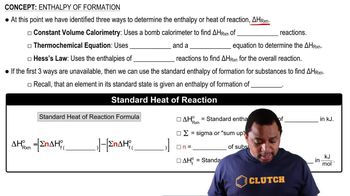
Enthalpy change (_x001F_H) is a measure of the heat content of a system at constant pressure. It indicates whether a reaction absorbs heat (endothermic, _x001F_H > 0) or releases heat (exothermic, _x001F_H < 0). Understanding the nature of the reactants and products, as well as their states (gas, liquid, solid), is crucial for predicting the sign of _x001F_H in a reaction.
Recommended video:
Guided course
Enthalpy of Formation
Phase Changes and Stability
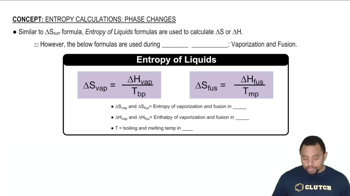
The stability of reactants and products in different phases (gas, liquid, solid) affects the enthalpy change. Generally, reactions that produce a more stable phase (like a solid from gases) tend to release energy, resulting in a negative _x001F_H. Conversely, reactions that involve breaking stable bonds or forming less stable phases may absorb energy, leading to a positive _x001F_H.
Recommended video:
Guided course
Entropy in Phase Changes
Bond Formation and Breaking
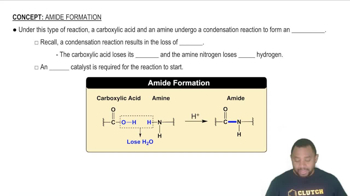
The energy associated with bond formation and breaking is fundamental in determining the enthalpy change of a reaction. Forming bonds releases energy (exothermic), while breaking bonds requires energy input (endothermic). Analyzing the bonds in the reactants and products helps predict whether the overall reaction will be exothermic or endothermic, thus indicating the sign of _x001F_H.
Recommended video:
Guided course
Amide Formation
Related Practice
Textbook Question
Textbook Question
Methanol (CH3OH) is used as a fuel in race cars. (c) Calculate the heat produced by combustion per liter of methanol. Methanol has a density of 0.791 g/mL.
Textbook Question
Methanol (CH3OH) is used as a fuel in race cars. (d) Calculate the mass of CO2 produced per kJ of heat emitted.
Textbook Question
Without doing any calculations, predict the sign of H foreach of the following reactions:(a) NaCl1s2¡Na+ 1g2 + Cl-1g2
Textbook Question
Use bond enthalpies in Table 5.4 to estimate H for each of the following reactions: (a)
