
Textbook Question
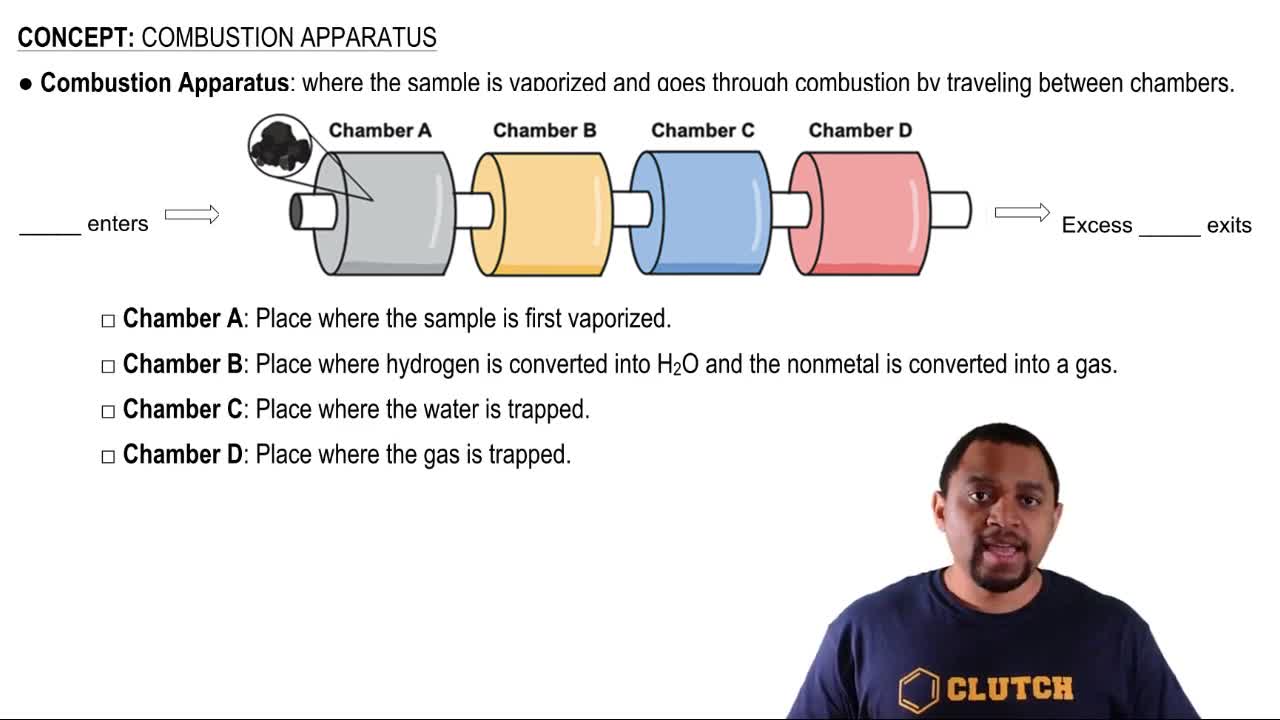
Ethanol (C2H5OH) is blended with gasoline as an automobile fuel. (d) Calculate the mass of CO2 produced per kJ of heat emitted.
 Verified step by step guidance
 02:24
02:24
 01:32
01:32 02:34
02:34Ethanol (C2H5OH) is blended with gasoline as an automobile fuel. (d) Calculate the mass of CO2 produced per kJ of heat emitted.
Ethanol (C2H5OH) is blended with gasoline as an automobile fuel. (b) Calculate the standard enthalpy change for the reaction, assuming H2O(g) as a product.
Ethanol (C2H5OH) is blended with gasoline as an automobile fuel. (c) Calculate the heat produced per liter of ethanol by combustion of ethanol under constant pressure. Ethanol has a density of 0.789 g/mL.
Calcium carbide (CaC2) reacts with water to form acetylene (C2H2) and Ca(OH)2. From the following enthalpy of reaction data and data in Appendix C, calculate H°f for CaC2(s): CaC2(s) + 2 H2O(l) → Ca(OH2)(s) + C2H2(g) ΔH° = -127.2 kJ
Gasoline is composed primarily of hydrocarbons, including many with eight carbon atoms, called octanes. One of the cleanest–burning octanes is a compound called 2,3,4- trimethylpentane, which has the following structural formula: The complete combustion of one mole of this compound to CO2(g) and H2O(g) leads to ΔH° = -5064.9 kJ. (b) By using the information in this problem and data in Table 5.3, calculate H°f for 2,3,4-trimethylpentane.
Complete combustion of 1 mol of acetone (C3H6O) liberates 1790 kJ: C3H6O(l) + 4 O2(g) → 3 CO2(g) + 3 H2O(l) ΔH° = -1790 kJ Using this information together with the standard enthalpies of formation of O2(g), CO2(g), and H2O(l) from Appendix C, calculate the standard enthalpy of formation of acetone.