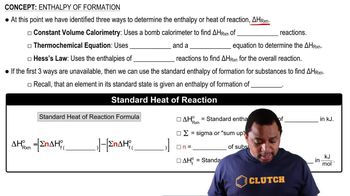
Consider two solutions, the first being 50.0 mL of 1.00 M CuSO4 and the second 50.0 mL of 2.00 M KOH. When the two solutions are mixed in a constant-pressure calorimeter, a precipitate forms and the temperature of the mixture rises from 21.5 to 27.7 °C (d) From the calorimetric data, calculate ΔH for the reaction that occurs on mixing. Assume that the calorimeter absorbs only a negligible quantity of heat, that the total volume of the solution is 100.0 mL, and that the specific heat and density of the solution after mixing are the same as those of pure water.
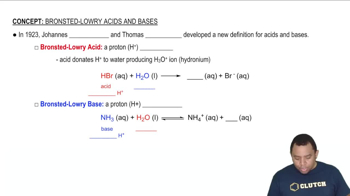
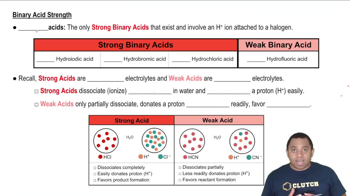
Consider the following acid-neutralization reactions involvingthe strong base NaOH(aq):HNO31aq2 + NaOH1aq2¡NaNO31aq2 + H2O1l2HCl1aq2 + NaOH1aq2¡NaCl1aq2 + H2O1l2NH4+1aq2 + NaOH1aq2¡NH31aq2 + Na+1aq2 + H2O1l2(d) In the third equation NH4+1aq2 is acting as an acid. Basedon the value of H° for this reaction, do you think it is astrong or a weak acid? Explain.
Verified step by step guidance
Verified video answer for a similar problem:
Key Concepts
Acid-Base Theory
Strength of Acids
Enthalpy Change (ΔH°)
Consider the following unbalanced oxidation-reduction reactions in aqueous solution:
Ag+(aq) + Li(s) → Ag(s) + Li+(aq)
Fe(s) + Na+(aq) → Fe2+(aq) + Na(s)
K(s) + H2O(l) → KOH(aq) + H2(g)
(d) Use the activity series to predict which of these reactions should occur. (Section 4.4) Are these results in accord with your conclusion in part (c) of this problem?
Consider two solutions, the first being 50.0 mL of 1.00 M CuSO4 and the second 50.0 mL of 2.00 M KOH. When the two solutions are mixed in a constant-pressure calorimeter, a precipitate forms and the temperature of the mixture rises from 21.5 to 27.7 °C. (a) Before mixing, how many grams of Cu are present in the solution of CuSO4?
Consider the following unbalanced oxidation-reduction reactions in aqueous solution:
Ag+(aq) + Li(s) → Ag(s) + Li+(aq)
Fe(s) + Na+(aq) → Fe2+(aq) + Na(s)
K(s) + H2O(l) → KOH(aq) + H2(g)
(a) Balance third reaction.
Consider the following unbalanced oxidation-reduction reactions in aqueous solution:
Ag+(aq) + Li(s) → Ag(s) + Li+(aq)
Fe(s) + Na+(aq) → Fe2+(aq) + Na(s)
K(s) + H2O(l) → KOH(aq) + H2(g)
(a) Balance second reaction.
