
Two solid objects, A and B, are placed in boiling water and allowed to come to the temperature of the water. Each is then lifted out and placed in separate beakers containing 1000 g of water at 10.0 °C. Object A increases the water temperature by 3.50 °C; B increases the water temperature by 2.60 °C. (b) What can you say about the specific heats of A and B?
Ch.5 - Thermochemistry
Brown14th EditionChemistry: The Central ScienceISBN: 9780134414232Not the one you use?Change textbook
Chapter 5, Problem 51a,b
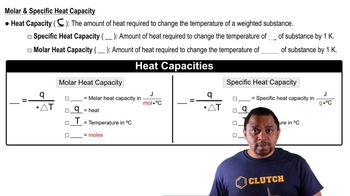
(a) What amount of heat (in joules) is required to raise the temperature of 1 g of water by 1 kelvin? (b) What amount of heat (in joules) is required to raise the temperature of 1 mole of water by 1 kelvin?
Verified step by step guidance1
Step 1: Understand the concept of specific heat capacity. The specific heat capacity of a substance is the amount of heat required to raise the temperature of 1 gram of the substance by 1 degree Celsius (or 1 Kelvin). For water, this value is approximately 4.18 J/g·K.
Step 2: Calculate the heat required for 1 gram of water. Since the specific heat capacity of water is 4.18 J/g·K, the amount of heat required to raise the temperature of 1 gram of water by 1 Kelvin is simply 4.18 joules.
Step 3: Determine the molar mass of water. Water (H₂O) has a molar mass of approximately 18.02 g/mol. This means 1 mole of water weighs 18.02 grams.
Step 4: Calculate the heat required for 1 mole of water. To find the heat required to raise the temperature of 1 mole of water by 1 Kelvin, multiply the specific heat capacity by the molar mass of water: \( q = 4.18 \text{ J/g·K} \times 18.02 \text{ g/mol} \).
Step 5: Simplify the expression to find the total heat in joules for 1 mole of water. This will give you the amount of heat required to raise the temperature of 1 mole of water by 1 Kelvin.

Verified video answer for a similar problem:
This video solution was recommended by our tutors as helpful for the problem above.
Video duration:
1mWas this helpful?
Key Concepts
Here are the essential concepts you must grasp in order to answer the question correctly.
Specific Heat Capacity
Specific heat capacity is the amount of heat required to raise the temperature of a unit mass of a substance by one degree Celsius (or one Kelvin). For water, this value is approximately 4.18 J/g·K, meaning it takes 4.18 joules to increase the temperature of 1 gram of water by 1 Kelvin. This concept is crucial for calculating heat transfer in thermal processes.
Recommended video:
Guided course
Heat Capacity
Molar Heat Capacity
Molar heat capacity refers to the amount of heat required to raise the temperature of one mole of a substance by one degree Celsius (or one Kelvin). For water, the molar heat capacity is about 75.3 J/mol·K. This concept is important when dealing with larger quantities of a substance, as it allows for calculations based on moles rather than mass.
Recommended video:
Guided course
Heat Capacity
Heat Transfer
Heat transfer is the process of thermal energy moving from one object or substance to another due to a temperature difference. In the context of the question, it involves calculating the heat required to change the temperature of water, which can be determined using the specific or molar heat capacities. Understanding heat transfer is essential for solving problems related to thermal energy changes in substances.
Recommended video:
Guided course
Heat Capacity
Related Practice
Textbook Question
Textbook Question
Two solid objects, A and B, are placed in boiling water and allowed to come to the temperature of the water. Each is then lifted out and placed in separate beakers containing 1000 g of water at 10.0 °C. Object A increases the water temperature by 3.50 °C; B increases the water temperature by 2.60 °C. (a) Which object has the larger heat capacity?
Textbook Question
(b) The specific heat of aluminum is 0.9 J/(g - K). Calculate its molar heat capacity.
Textbook Question
(d) How many kJ of heat are needed to raise the temperature of 5.00 kg of liquid water from 24.6 to 46.2 °C?
Textbook Question
(b) Calculate the energy needed for this temperature change.
Textbook Question
(c) What is the heat capacity of 185 g of liquid water?
1
views
