Consider the reaction 2 H2(g) + O2(g) → 2 H2O(l). (a) Use the bond enthalpies in Table 5.4 to estimate H for this reaction, ignoring the fact that water is in the liquid state.
Ch.5 - Thermochemistry
Brown14th EditionChemistry: The Central ScienceISBN: 9780134414232Not the one you use?Change textbook
Chapter 5, Problem 85
(a) Use enthalpies of formation given in Appendix C to calculate _x001F_H for the reaction Br2(g) → 2 Br(g), and use this value to estimate the bond enthalpy D(Br–Br). (b) How large is the difference between the value calculated in part (a) and the value given in Table 5.4?
Verified step by step guidance1
Step 1: Write the balanced chemical equation for the reaction: Br2(g) → 2 Br(g).
Step 2: Use the standard enthalpy of formation values (ΔH_f°) from Appendix C for Br2(g) and Br(g). Note that the standard enthalpy of formation for an element in its standard state, like Br2(g), is zero.
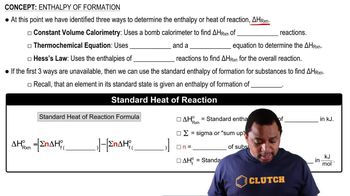
Step 3: Apply Hess's Law to calculate the enthalpy change (ΔH) for the reaction using the formula: ΔH = Σ(ΔH_f° of products) - Σ(ΔH_f° of reactants).
Step 4: Recognize that the calculated ΔH for the reaction represents the bond enthalpy D(Br–Br) because breaking one mole of Br2(g) into two moles of Br(g) involves breaking the Br–Br bond.
Step 5: Compare the calculated bond enthalpy D(Br–Br) with the value given in Table 5.4 to determine the difference.
Key Concepts
Here are the essential concepts you must grasp in order to answer the question correctly.
Enthalpy of Formation
Enthalpy of formation is the change in enthalpy when one mole of a compound is formed from its elements in their standard states. It is a crucial concept in thermodynamics, as it allows for the calculation of the overall energy change in chemical reactions. By using standard enthalpies of formation, one can determine the enthalpy change for reactions involving multiple substances.
Recommended video:
Guided course
Enthalpy of Formation
Bond Enthalpy
Bond enthalpy, or bond dissociation energy, is the energy required to break one mole of a specific type of bond in a gaseous substance. It reflects the strength of a bond; stronger bonds have higher bond enthalpies. In the context of the reaction Br2(g) → 2 Br(g), the bond enthalpy D(Br–Br) can be estimated from the enthalpy change calculated for the reaction.
Recommended video:
Guided course
Enthalpy of Formation
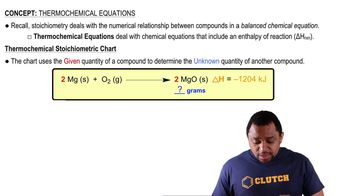
Thermochemical Equations
Thermochemical equations represent the relationship between heat and chemical reactions, often including the enthalpy change associated with the reaction. These equations allow chemists to quantify energy changes and compare them with tabulated values, such as those found in standard tables. Understanding how to manipulate these equations is essential for calculating differences in enthalpy values, as required in part (b) of the question.
Recommended video:
Guided course
Thermochemical Equations
Related Practice
Textbook Question
Textbook Question
(a) The nitrogen atoms in an N2 molecule are held together by a triple bond; use enthalpies of formation in Appendix C to estimate the enthalpy of this bond, D(N‚N). (b) Consider the reaction between hydrazine and hydrogen to produce ammonia, N2H41g2 + H21g2¡2 NH31g2. Use enthalpies of formation and bond enthalpies to estimate the enthalpy of the nitrogen– nitrogen bond in N2H4. (c) Based on your answers to parts (a) and (b), would you predict that the nitrogen–nitrogen bond in hydrazine is weaker than, similar to, or stronger than the bond in N2 ?
Textbook Question
Without doing any calculations, predict the sign of H foreach of the following reactions:(a) NaCl1s2¡Na+ 1g2 + Cl-1g2
Textbook Question
Use bond enthalpies in Table 5.4 to estimate H for each of the following reactions: (a)