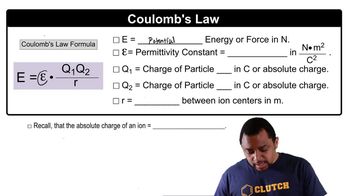
A sodium ion, Na+, with a charge of 1.6⨉10-19 C and a chloride ion, Cl - , with charge of -1.6⨉10-19 C, are separated by a distance of 0.50 nm. How much work would be required to increase the separation of the two ions to an infinite distance?
A magnesium ion, Mg2+, with a charge of 3.2⨉10-19 C and an oxide ion, O2-, with a charge of -3.2⨉10-19 C, are separated by a distance of 0.35 nm. How much work would be required to increase the separation of the two ions to an infinite distance?
Verified step by step guidance
Verified video answer for a similar problem:
Key Concepts
Coulomb's Law
Electric Potential Energy
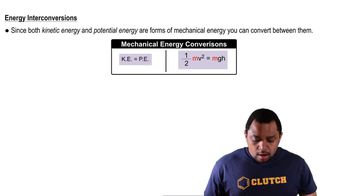
Work-Energy Principle
(a) The electrostatic force (not energy) of attraction between two oppositely charged objects is given by the equation F = k (Q1Q2/d2) where k = 8.99⨉109N-m2/C2, Q1 and Q2 are the charges of the two objects in Coulombs, and d is the distance separating the two objects in meters. What is the electrostatic force of attraction (in Newtons) between an electron and a proton that are separated by 1⨉102 pm?
In a thermodynamic study, a scientist focuses on the properties of a solution in an apparatus as illustrated. A solution is continuously flowing into the apparatus at the top and out at the bottom, such that the amount of solution in the apparatus is constant with time. (a) Is the solution in the apparatus a closed system, open system, or isolated system?
