Write balanced molecular and net ionic equations for the following reactions, and identify the gas formed in each: (a) solid cadmium sulfide reacts with an aqueous solution of sulfuric acid (b) solid magnesium carbonate reacts with an aqueous solution of perchloric acid.
Ch.4 - Reactions in Aqueous Solution
Brown14th EditionChemistry: The Central ScienceISBN: 9780134414232Not the one you use?Change textbook
Chapter 4, Problem 40a
Write the balanced molecular and net ionic equations for each of the following neutralization reactions: (a) Aqueous acetic acid is neutralized by aqueous barium hydroxide
Verified step by step guidance1
Identify the reactants: acetic acid (CH₃COOH) and barium hydroxide (Ba(OH)₂).
Write the unbalanced molecular equation: CH₃COOH(aq) + Ba(OH)₂(aq) → Ba(CH₃COO)₂(aq) + H₂O(l).
Balance the molecular equation by ensuring the number of atoms of each element is equal on both sides.
Write the complete ionic equation by dissociating all strong electrolytes into their ions.
Identify and cancel the spectator ions to write the net ionic equation, focusing on the ions that participate in the reaction.

Verified video answer for a similar problem:
This video solution was recommended by our tutors as helpful for the problem above.
Video duration:
3mWas this helpful?
Key Concepts
Here are the essential concepts you must grasp in order to answer the question correctly.
Neutralization Reactions
Neutralization reactions occur when an acid reacts with a base to produce water and a salt. In this process, the hydrogen ions (H+) from the acid combine with hydroxide ions (OH-) from the base to form water (H2O). Understanding the general form of these reactions is essential for writing balanced equations.
Recommended video:
Guided course
Lewis Dot Structures: Neutral Compounds
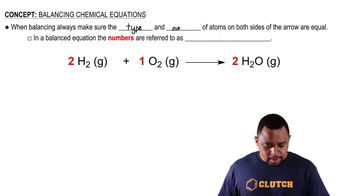
Balanced Molecular Equations
A balanced molecular equation represents the reactants and products of a chemical reaction with their respective coefficients, ensuring that the number of atoms for each element is the same on both sides. This is crucial for accurately depicting the stoichiometry of the reaction and is the first step in deriving the net ionic equation.
Recommended video:
Guided course
Balancing Chemical Equations
Net Ionic Equations
Net ionic equations show only the species that participate in the reaction, omitting spectator ions that do not change during the reaction. This simplification highlights the actual chemical change occurring, which is particularly important in reactions involving strong electrolytes, such as the neutralization of acetic acid by barium hydroxide.
Recommended video:
Guided course
Net Ionic Equations
Related Practice
Textbook Question
Textbook Question
Write the balanced molecular and net ionic equations for each of the following neutralization reactions: (c) Aqueous nitric acid and aqueous ammonia react.
Textbook Question
Write the balanced molecular and net ionic equations for each of the following neutralization reactions: (b) Solid chromium(III) hydroxide reacts with nitrous acid.
Textbook Question
Complete and balance the following molecular equations, and then write the net ionic equation for each:
(a) HBr(aq) + Ca(OH)2(aq) →
(b) Cu(OH)2(s) + HClO4(aq) →
(c) Al(OH)3(s) + HNO3(aq) →
Textbook Question
Classify each of the following substances as a nonelectrolyte, weak electrolyte, or strong electrolyte in water: (a) HF (b) C6H5COOH (benzoic acid) (c) C6H6 (benzene) (d) CoCl3 (e) AgNO3.
