(b) Because atoms are spherical, they cannot occupy all of the space of the cube. The silver atoms pack in the solid in such a way that 74% of the volume of the solid is actually filled with the silver atoms. Calculate the volume of a single silver atom.
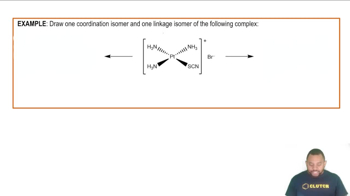
Section 2.9 introduced the idea of structural isomerism, with 1-propanol and 2-propanol as examples. Determine which of these properties would distinguish these two substances: (a) boiling point, (b) combustion analysis results, (c) molecular weight, (d) density at a given temperature and pressure. You can check on the properties of these two compounds in Wolfram Alpha (http://www.wolframalpha.com/) or the CRC Handbook of Chemistry and Physics.
Verified step by step guidanceKey Concepts
Structural Isomerism
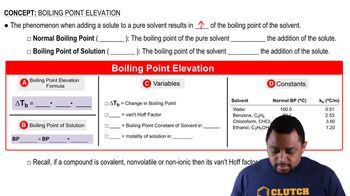
Boiling Point
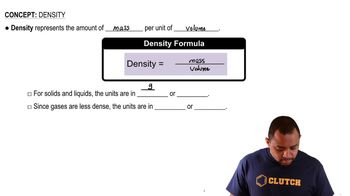
Density
Hydrogen cyanide, HCN, is a poisonous gas. The lethal dose is approximately 300 mg HCN per kilogram of air when inhaled. (a) Calculate the amount of HCN that gives the lethal dose in a small laboratory room measuring 3.5 × 4.5 × 2.5 m. The density of air at 26 °C is 0.00118 g/cm3. (b) If the HCN is formed by reaction of NaCN with an acid such as H2SO4, what mass of NaCN gives the lethal dose in the room? 2 NaCN(s) + H2SO4(aq) → Na2SO4(aq) + 2 HCN(g)
Hydrogen cyanide, HCN, is a poisonous gas. The lethal dose is approximately 300 mg HCN per kilogram of air when inhaled. (c) HCN forms when synthetic fibers containing Orlon® or Acrilan ® burn. Acrilan® has an empirical formula of CH2CHCN, so HCN is 50.9% of the formula by mass. A rug measures 3.5 × 4.5 m and contains 850 g of Acrilan® fibers per square yard of carpet. If the rug burns, will a lethal dose of HCN be generated in the room? Assume that the yield of HCN from the fibers is 20% and that the carpet is 50% consumed.
Burning acetylene in oxygen can produce three different carbon-containing products: soot (very fine particles of graphite), CO(g), and CO2(g). (c) Why, when the oxygen supply is adequate, is CO2(g) the predominant carbon-containing product of the combustion of acetylene?
