
Textbook Question
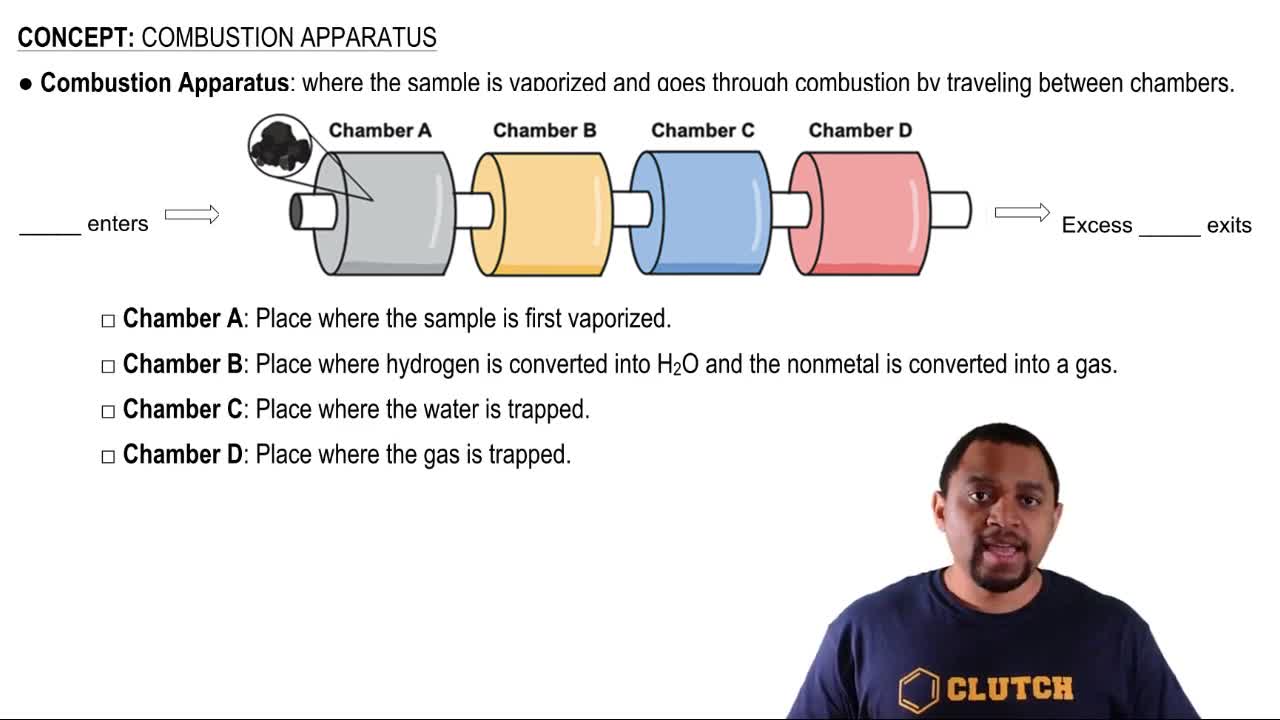
If 2.0 mol CH3CH2CH2COOH, 2.0 mol C4H10, and 2.0 mol C6H6 are completely combusted in oxygen, which one produces the least? Explain.
 Verified step by step guidance
 02:24
02:24
 01:16
01:16 02:11
02:11If 2.0 mol CH3CH2CH2COOH, 2.0 mol C4H10, and 2.0 mol C6H6 are completely combusted in oxygen, which one produces the least? Explain.
When hydrogen sulfide gas is bubbled into a solution of sodium hydroxide, the reaction forms sodium sulfide and water. How many grams of sodium sulfide are formed if 1.25 g of hydrogen sulfide is bubbled into a solution containing 2.00 g of sodium hydroxide, assuming that the sodium sulfide is made in 92.0% yield?
Write balanced chemical equations for (a) the complete combustion of acetone (CH3COCH3), a common organic solvent (b) the decomposition of solid mercury (I) carbonate into carbon dioxide gas, mercury, and solid mercury oxide
Write balanced chemical equations for (c) the combination reaction between nickel metal and chlorine gas.
(a) Ibuprofen is a common over-the-counter analgesic with the formula C13H18O2. How many moles of C13H18O2 are in a 500-mg tablet of ibuprofen? Assume the tablet is composed entirely of ibuprofen.