Consider the mixture of propane, C3H8, and O2 shown here. (c) How many molecules of CO2, H2O, C3H8, and O2 will be present if the reaction goes to completion?
Ch.3 - Chemical Reactions and Reaction Stoichiometry
Brown14th EditionChemistry: The Central ScienceISBN: 9780134414232Not the one you use?Change textbook
Chapter 3, Problem 76a
Consider the mixture of propane, C3H8, and O2 shown here. (a) Write a balanced equation for the combustion reaction that occurs between propane and oxygen.
Verified step by step guidance1
Start by writing the unbalanced chemical equation for the combustion of propane: \( \text{C}_3\text{H}_8 + \text{O}_2 \rightarrow \text{CO}_2 + \text{H}_2\text{O} \)
Balance the carbon atoms first. Propane has 3 carbon atoms, so you need 3 \( \text{CO}_2 \) molecules: \( \text{C}_3\text{H}_8 + \text{O}_2 \rightarrow 3\text{CO}_2 + \text{H}_2\text{O} \)
Next, balance the hydrogen atoms. Propane has 8 hydrogen atoms, so you need 4 \( \text{H}_2\text{O} \) molecules: \( \text{C}_3\text{H}_8 + \text{O}_2 \rightarrow 3\text{CO}_2 + 4\text{H}_2\text{O} \)
Now, balance the oxygen atoms. You have 3 \( \text{CO}_2 \) molecules and 4 \( \text{H}_2\text{O} \) molecules, which means you need a total of 10 oxygen atoms (6 from \( \text{CO}_2 \) and 4 from \( \text{H}_2\text{O} \)): \( \text{C}_3\text{H}_8 + 5\text{O}_2 \rightarrow 3\text{CO}_2 + 4\text{H}_2\text{O} \)
Verify that all atoms are balanced: 3 carbon atoms, 8 hydrogen atoms, and 10 oxygen atoms on both sides of the equation.

Verified video answer for a similar problem:
This video solution was recommended by our tutors as helpful for the problem above.
Video duration:
4mWas this helpful?
Key Concepts
Here are the essential concepts you must grasp in order to answer the question correctly.
Combustion Reactions
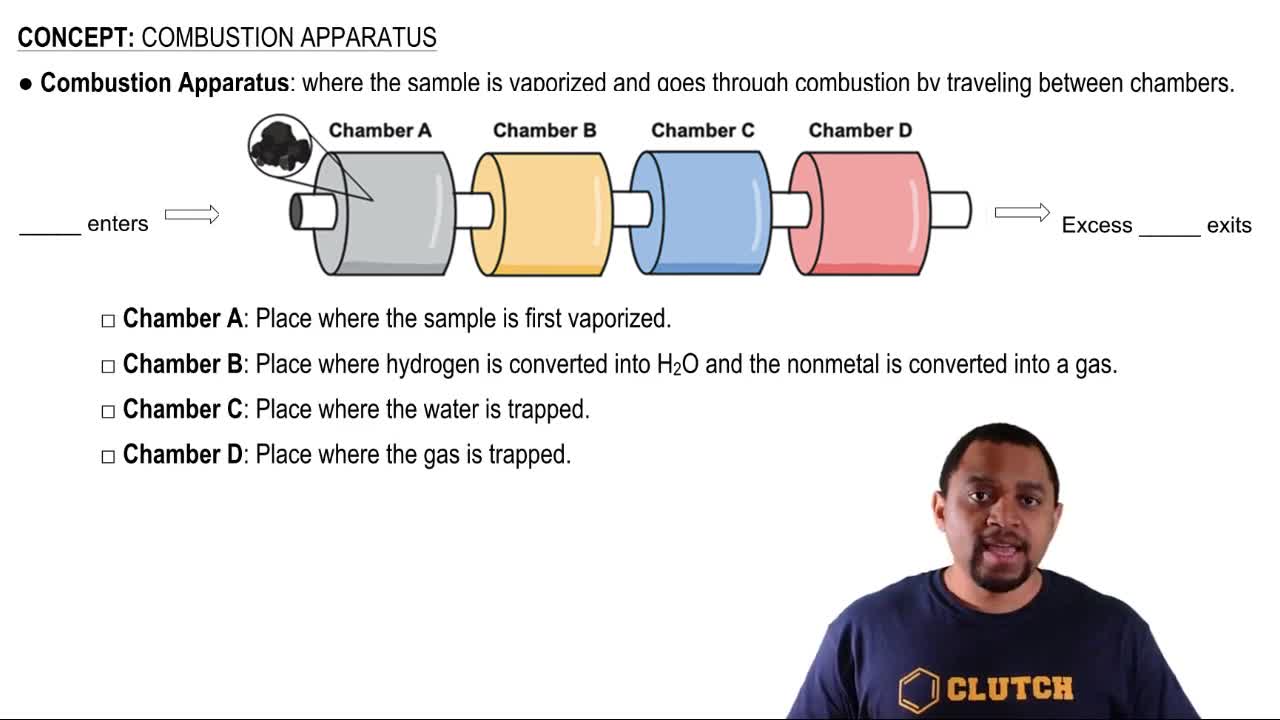
Combustion reactions are chemical processes in which a substance reacts rapidly with oxygen, producing heat and light. In organic compounds like propane, the reaction typically produces carbon dioxide and water as products. Understanding the general form of combustion reactions is essential for writing balanced equations.
Recommended video:
Guided course
Combustion Apparatus
Balancing Chemical Equations
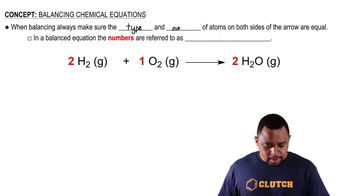
Balancing chemical equations involves ensuring that the number of atoms of each element is the same on both sides of the equation. This is achieved by adjusting the coefficients of the reactants and products. A balanced equation reflects the law of conservation of mass, which states that matter cannot be created or destroyed in a chemical reaction.
Recommended video:
Guided course
Balancing Chemical Equations
Stoichiometry
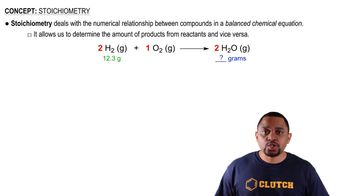
Stoichiometry is the quantitative relationship between reactants and products in a chemical reaction. It allows chemists to calculate the amounts of substances consumed and produced in a reaction. In the context of combustion, stoichiometry helps determine the precise ratios of propane and oxygen needed to achieve complete combustion.
Recommended video:
Guided course
Stoichiometry Concept
Related Practice
Textbook Question
Textbook Question
Consider the mixture of ethanol, C2H5OH, and O2 shown in the accompanying diagram. (c) How many molecules of CO2, H2O, C2H5OH, and O2 will be present if the reaction goes to completion?
Textbook Question
Consider the mixture of ethanol, C2H5OH, and O2 shown in the accompanying diagram. (b) Which reactant is the limiting reactant?
Textbook Question
(c) Can a reaction ever have 110% actual yield?
Textbook Question
Sodium hydroxide reacts with carbon dioxide as follows: 2 NaOH(s) + CO2(g) → Na2CO3(s) + H2O(l) How many moles of Na2CO3 can be produced?
Textbook Question
Sodium hydroxide reacts with carbon dioxide as follows: 2 NaOH(s) + CO2(g) → Na2CO3(s) + H2O(l) Which is the limiting reactant when 1.85 mol NaOH and 1.00 mol CO2 are allowed to react?