
Textbook Question
Calcium hydride reacts with water to form calcium hydroxide and hydrogen gas. (a) Write a balanced chemical equation for the reaction.
 Verified step by step guidance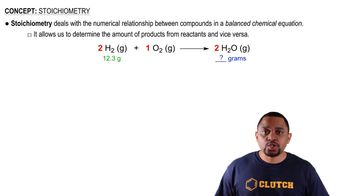
 01:16
01:16
 02:11
02:11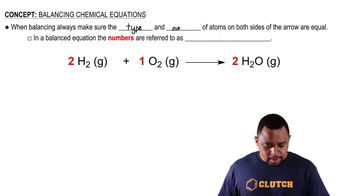 01:32
01:32Calcium hydride reacts with water to form calcium hydroxide and hydrogen gas. (a) Write a balanced chemical equation for the reaction.
The complete combustion of octane, C8H18, a component of gasoline, proceeds as follows: 2 C8H18(l) + 25 O2(g) → 16 CO2(g) + 18 H2O(g) (b) How many grams of O2 are needed to burn 10.0 g of C8H18?
The complete combustion of octane, C8H18, a component of gasoline, proceeds as follows: 2 C8H18(l) + 25 O2(g) → 16 CO2(g) + 18 H2O(g) (a) How many moles of O2 are needed to burn 1.50 mol of C8H18?
Aluminum sulfide reacts with water to form aluminum hydroxide and hydrogen sulfide. (a) Write the balanced chemical equation for this reaction. (b) How many grams of aluminum hydroxide are obtained from 14.2 g of aluminum sulfide?
An iron ore sample contains Fe2O3 together with other substances. Reaction of the ore with CO produces iron metal: Fe2O3(s) + CO(g) → Fe(s) + CO2(g) (b) Calculate the number of grams of CO that can react with 0.350 kg of Fe2O3. (c) Calculate the number of grams of Fe and the number of grams of CO2 formed when 0.350 kg of Fe2O3 reacts.
Automotive air bags inflate when sodium azide, NaN3, rapidly decomposes to its component elements: 2 NaN31s2¡2 Na1s2 + 3 N21g2 (c) How many grams of NaN3 are required to produce 10.0 ft3 of nitrogen gas, about the size of an automotive air bag, if the gas has a density of 1.25 g/L?