Aqueous solutions of ammonia (NH3) and bleach (active ingredient NaOCl) are sold as cleaning fluids, but bottles of both of them warn: 'Never mix ammonia and bleach, as toxic gases may be produced.' One of the toxic gases that can be produced is chloroamine, NH2Cl. (a) What is the oxidation number of chlorine in bleach? (active ingredient NaOCl) are sold as cleaning fluids, but bottles of both of them warn: “Never mix ammonia and bleach, as toxic gases may be produced.” One of the toxic gases that can be produced is chloroamine, NH2Cl. (b) What is the oxidation number of chlorine in chloramine? (d) Another toxic gas that can be produced is nitrogen trichloride, NCl3. What is the oxidation number of N in nitrogen trichloride?
Ch.20 - Electrochemistry
Brown14th EditionChemistry: The Central ScienceISBN: 9780134414232Not the one you use?Change textbook
Chapter 20, Problem 111
The Haber process is the principal industrial route for converting nitrogen into ammonia: N2(g) + 3 H2(g) → 2 NH3(g). (c) Calculate the standard emf of the Haber process at room temperature.
Verified step by step guidance1
Identify the half-reactions involved in the Haber process. The reduction half-reaction is: \( \text{N}_2(g) + 6 \text{e}^- + 6 \text{H}^+ \rightarrow 2 \text{NH}_3(g) \). The oxidation half-reaction is: \( 3 \text{H}_2(g) \rightarrow 6 \text{H}^+ + 6 \text{e}^- \).
Determine the standard reduction potentials for each half-reaction. You can find these values in a standard reduction potential table. Note that the reduction potential for \( \text{N}_2 \) to \( \text{NH}_3 \) is typically negative, indicating it is not spontaneous under standard conditions.
Calculate the standard cell potential (emf) using the formula: \( E^\circ_{\text{cell}} = E^\circ_{\text{cathode}} - E^\circ_{\text{anode}} \). Substitute the standard reduction potentials for the cathode (reduction of \( \text{N}_2 \)) and anode (oxidation of \( \text{H}_2 \)).
Consider the sign of the calculated emf. If the emf is negative, the reaction is non-spontaneous under standard conditions, which is typical for the Haber process.
Reflect on the implications of the calculated emf for industrial applications. The Haber process requires specific conditions such as high pressure and temperature to proceed efficiently, overcoming the non-spontaneous nature indicated by the standard emf.
Key Concepts
Here are the essential concepts you must grasp in order to answer the question correctly.
Haber Process
The Haber process is a chemical reaction that synthesizes ammonia from nitrogen and hydrogen gases. It is represented by the equation N2(g) + 3 H2(g) → 2 NH3(g). This process is crucial for producing fertilizers and has significant implications for agriculture and food production.
Recommended video:
Guided course
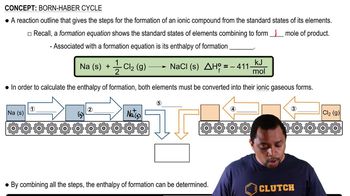
Born Haber Cycle
Standard Electromotive Force (emf)
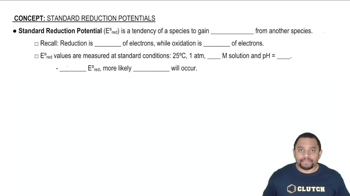
Standard electromotive force (emf) is the measure of the voltage generated by a chemical reaction under standard conditions (1 M concentration, 1 atm pressure, and 25°C). It indicates the tendency of a chemical reaction to occur spontaneously, with positive values suggesting a favorable reaction.
Recommended video:
Guided course
Standard Reduction Potentials
Nernst Equation
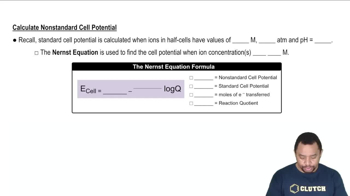
The Nernst equation relates the standard emf of a reaction to its concentrations at non-standard conditions. It is expressed as E = E° - (RT/nF) ln(Q), where E° is the standard emf, R is the gas constant, T is the temperature in Kelvin, n is the number of moles of electrons transferred, F is Faraday's constant, and Q is the reaction quotient. This equation is essential for calculating the emf of the Haber process at room temperature.
Recommended video:
Guided course
The Nernst Equation
Related Practice
Textbook Question
Textbook Question
Calculate the number of kilowatt-hours of electricity required to produce 1.0 * 103 kg (1 metric ton) of aluminum by electrolysis of Al3+ if the applied voltage is 4.50 V and the process is 45% efficient.
Textbook Question
The Haber process is the principal industrial route for converting nitrogen into ammonia: N2(g) + 3 H2(g) → 2 NH3(g) (b) Using the thermodynamic data in Appendix C, calculate the equilibrium constant for the process at room temperature.
