A 1.0-g sample of carbon dioxide (CO2) is fully decomposed into its elements, yielding 0.273 g of carbon and 0.727 g of oxygen. (a) What is the ratio of the mass of O to C?
Ch.2 - Atoms, Molecules, and Ions
Brown14th EditionChemistry: The Central ScienceISBN: 9780134414232Not the one you use?Change textbook
Chapter 2, Problem 7
Five of the boxes in the following periodic table are colored. Predict the charge on the ion associated with each of these elements.
Verified step by step guidance1
Identify the position of each colored element in the periodic table to determine its group number.
Recall that elements in the same group typically form ions with the same charge due to having the same number of valence electrons.
For main group elements, use the group number to predict the charge: elements in Group 1 form +1 ions, Group 2 form +2 ions, Group 13 form +3 ions, Group 15 form -3 ions, Group 16 form -2 ions, and Group 17 form -1 ions.
Consider any exceptions or special cases, such as transition metals, which may have multiple possible charges.
Write down the predicted charge for each element based on its group and typical ion formation behavior.

Verified video answer for a similar problem:
This video solution was recommended by our tutors as helpful for the problem above.
Video duration:
1mWas this helpful?
Key Concepts
Here are the essential concepts you must grasp in order to answer the question correctly.
Periodic Table and Element Groups
The periodic table organizes elements based on their atomic number and properties. Elements are grouped into columns (groups) that share similar chemical behaviors. For example, alkali metals in Group 1 typically form +1 ions, while halogens in Group 17 usually form -1 ions. Understanding an element's position in the periodic table helps predict its ionic charge.
Recommended video:
Guided course
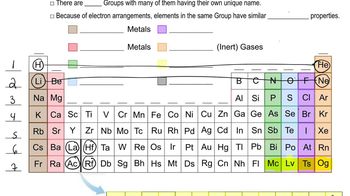
Periodic Table: Group Names
Ionic Charge and Electron Configuration
Ionic charge refers to the electrical charge an atom acquires when it loses or gains electrons to achieve a stable electron configuration, often resembling that of noble gases. Metals tend to lose electrons and form positive ions (cations), while nonmetals gain electrons to form negative ions (anions). This concept is crucial for predicting the charges of ions formed by different elements.
Recommended video:
Guided course
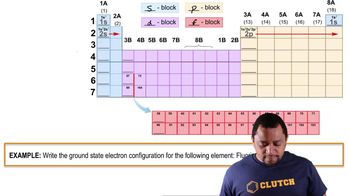
Electron Configuration Example
Trends in Ionic Charges
Ionic charges exhibit predictable trends across the periodic table. For instance, elements in the same group often form ions with the same charge due to their similar valence electron configurations. Additionally, as you move from left to right across a period, the tendency to gain electrons increases, leading to more negative charges for nonmetals. Recognizing these trends aids in accurately predicting the charges of ions.
Recommended video:
Guided course
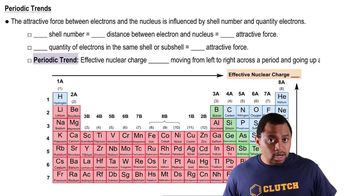
Effective Nuclear Charge Trends
Related Practice
Textbook Question
1
views
Textbook Question
Does the following drawing represent a neutral atom or an ion?
3
views
Textbook Question
In the Millikan oil-drop experiment (see Figure 2.5), the tiny oil drops are observed through the viewing lens as rising, stationary, or falling, as shown here. (a) What causes their rate of fall to vary from their rate in the absence of an electric field?
Textbook Question
Which of the following diagrams most likely represents an ionic compound, and which represents a molecular one? Explain your choice.
Textbook Question
The following diagram represents an ionic compound in which the red spheres represent cations and the blue spheres represent anions. Which of the following formulas is consistent with the drawing? KBr, K2SO4, Ca1NO322, Fe21SO423.
2
views