The reaction SO2(g) + 2 H2S(g) ⇌ 3 S(s) + 2 H2O(g) is the basis of a suggested method for removal of SO2 from power-plant stack gases. The standard free energy of each substance is given in Appendix C. (a) What is the equilibrium constant for the reaction at 298 K? (c) If PSO2 = PH2S and the vapor pressure of water is 25 torr, calculate the equilibrium SO2 pressure in the system at 298 K.
Ch.19 - Chemical Thermodynamics
Brown14th EditionChemistry: The Central ScienceISBN: 9780134414232Not the one you use?Change textbook
Chapter 19, Problem 111b
The reaction SO2(g) + 2 H2S(g) ⇌ 3 S(s) + 2 H2O(g) is the basis of a suggested method for removal of SO2 from power-plant stack gases. The standard free energy of each substance is given in Appendix C. (b) In principle, is this reaction a feasible method of removing SO2?
Verified step by step guidance1
Identify the standard free energy of formation (\( \Delta G^\circ_f \)) for each substance involved in the reaction from Appendix C.
Write the balanced chemical equation: \( \text{SO}_2(g) + 2 \text{H}_2\text{S}(g) \rightleftharpoons 3 \text{S}(s) + 2 \text{H}_2\text{O}(g) \).
Calculate the standard free energy change (\( \Delta G^\circ \)) for the reaction using the formula: \( \Delta G^\circ = \sum \Delta G^\circ_f(\text{products}) - \sum \Delta G^\circ_f(\text{reactants}) \).
Determine the sign of \( \Delta G^\circ \). If \( \Delta G^\circ < 0 \), the reaction is spontaneous under standard conditions, suggesting feasibility.
Discuss the implications of the \( \Delta G^\circ \) value in terms of the reaction's feasibility for removing \( \text{SO}_2 \) from power-plant stack gases.

Verified video answer for a similar problem:
This video solution was recommended by our tutors as helpful for the problem above.
Video duration:
4mWas this helpful?
Key Concepts
Here are the essential concepts you must grasp in order to answer the question correctly.
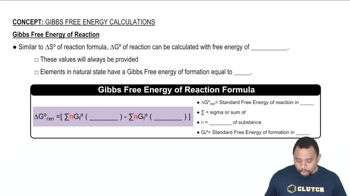
Gibbs Free Energy
Gibbs Free Energy (G) is a thermodynamic potential that measures the maximum reversible work obtainable from a thermodynamic system at constant temperature and pressure. A negative change in Gibbs Free Energy (ΔG) indicates that a reaction is spontaneous and can occur without external energy input. Understanding ΔG is crucial for assessing the feasibility of chemical reactions, such as the removal of SO₂ in this context.
Recommended video:
Guided course
Gibbs Free Energy of Reactions
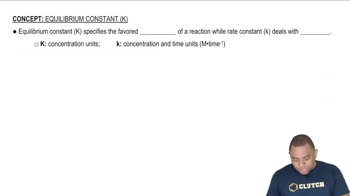
Equilibrium Constant
The equilibrium constant (K) quantifies the ratio of the concentrations of products to reactants at equilibrium for a reversible reaction. It provides insight into the position of equilibrium and the extent to which a reaction proceeds. For the reaction in question, analyzing K can help determine whether the formation of products (S and H₂O) is favored over the reactants (SO₂ and H₂S), indicating the feasibility of SO₂ removal.
Recommended video:
Guided course
Equilibrium Constant K
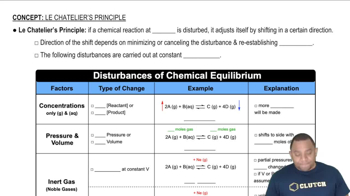
Le Chatelier's Principle
Le Chatelier's Principle states that if a dynamic equilibrium is disturbed by changing the conditions, the system will adjust to counteract the change and restore a new equilibrium. This principle is essential for understanding how changes in concentration, pressure, or temperature can affect the reaction's direction and feasibility, particularly in the context of removing SO₂ from stack gases.
Recommended video:
Guided course
Le Chatelier's Principle
Related Practice
Textbook Question
Textbook Question
Consider the following equilibrium: N2O4(g) ⇌ 2 NO2(g) Thermodynamic data on these gases are given in Appendix C. You may assume that ΔH° and ΔS° do not vary with temperature. (a) At what temperature will an equilibrium mixture contain equal amounts of the two gases?
Textbook Question
The reaction SO2(g) + 2 H2S(g) ⇌ 3 S(s) + 2 H2O(g) is the basis of a suggested method for removal of SO2 from power-plant stack gases. The standard free energy of each substance is given in Appendix C. (d) Would you expect the process to be more or less effective at higher temperatures?
Textbook Question
The following data compare the standard enthalpies and free energies of formation of some crystalline ionic substances and aqueous solutions of the substances:
