Consider a reaction A2(𝑔) + B2(𝑔) ⇌ 2 AB(𝑔), atoms of A shown in red in the diagram and atoms of B shown in blue. (a) If 𝐾𝑐 = 1, which box represents the system at equilibrium?
Ch.19 - Chemical Thermodynamics
Brown14th EditionChemistry: The Central ScienceISBN: 9780134414232Not the one you use?Change textbook
Chapter 19, Problem 7b
The accompanying diagram shows how ΔH (red line) and TΔS (blue line) change with temperature for a hypothetical reaction.
(b) In what temperature range is this reaction spontaneous?
Verified step by step guidance1
Understand the concept of spontaneity: A reaction is spontaneous when the change in Gibbs free energy (\( \Delta G \)) is negative. The equation for Gibbs free energy is \( \Delta G = \Delta H - T\Delta S \).
Identify the given variables: \( \Delta H \) is the change in enthalpy, \( T \) is the temperature in Kelvin, and \( \Delta S \) is the change in entropy.
Determine the relationship between \( \Delta H \) and \( T\Delta S \): For the reaction to be spontaneous, \( \Delta H < T\Delta S \).
Analyze the diagram: Look for the temperature range where the blue line (\( T\Delta S \)) is above the red line (\( \Delta H \)).
Conclude the temperature range: The reaction is spontaneous in the temperature range where the blue line is above the red line, indicating \( \Delta G < 0 \).

Verified video answer for a similar problem:
This video solution was recommended by our tutors as helpful for the problem above.
Video duration:
1mWas this helpful?
Key Concepts
Here are the essential concepts you must grasp in order to answer the question correctly.
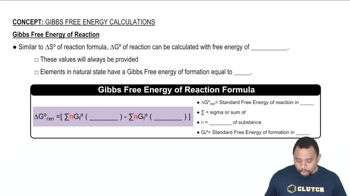
Gibbs Free Energy
Gibbs Free Energy (G) is a thermodynamic potential that helps predict the spontaneity of a reaction. A reaction is spontaneous when the change in Gibbs Free Energy (ΔG) is negative. The relationship is given by the equation ΔG = ΔH - TΔS, where ΔH is the change in enthalpy, T is the temperature in Kelvin, and ΔS is the change in entropy.
Recommended video:
Guided course
Gibbs Free Energy of Reactions
Enthalpy (ΔH)
Enthalpy (ΔH) is a measure of the total heat content of a system. In the context of a reaction, it indicates whether the reaction absorbs heat (endothermic, ΔH > 0) or releases heat (exothermic, ΔH < 0). The sign and magnitude of ΔH influence the spontaneity of the reaction, particularly at different temperatures.
Recommended video:
Guided course
Enthalpy of Formation
Entropy (ΔS)
Entropy (ΔS) is a measure of the disorder or randomness in a system. A positive change in entropy (ΔS > 0) indicates an increase in disorder, which favors spontaneity. The temperature (T) plays a crucial role in the Gibbs Free Energy equation, as higher temperatures can make a reaction spontaneous even if ΔH is positive, provided ΔS is also positive.
Recommended video:
Guided course
Entropy in Thermodynamics
Related Practice
Textbook Question
2
views
Textbook Question
Consider a reaction A2(𝑔) + B2(𝑔) ⇌ 2 AB(𝑔), atoms of A shown in red in the diagram and atoms of B shown in blue. (b) If 𝐾𝑐 = 1, which box represents the system at 𝑄 < 𝐾𝑐?
1
views
Textbook Question
Isomers are molecules that have the same chemical formula but different arrangements of atoms, as shown here for two isomers of pentane, C5H12.
(a) Do you expect a significant difference in the enthalpy of combustion of the two isomers? Explain.
Textbook Question
Isomers are molecules that have the same chemical formula but different arrangements of atoms, as shown here for two isomers of pentane, C5H12.
(b) Which isomer do you expect to have the higher standard molar entropy? Explain.