
Consider the following reaction between oxides of nitrogen: NO2(g) + N2O(g) → 3 NO(g) (b) Calculate ΔG at 800 K, assuming that ΔH° and ΔS° do not change with temperature. Under standard conditions is the reaction spontaneous at 800 K?
Ch.19 - Chemical Thermodynamics
Brown14th EditionChemistry: The Central ScienceISBN: 9780134414232Not the one you use?Change textbook
Chapter 19, Problem 70b
Methanol (CH3OH) can be made by the controlled oxidation of methane: CH4(g) + 12 O2(g) → CH3OH(g) (b) Will ΔG for the reaction increase, decrease, or stay unchanged with increasing temperature?
Verified step by step guidance1
Step 1: Understand that the Gibbs free energy change (ΔG) of a reaction is related to the temperature, the enthalpy change (ΔH), and the entropy change (ΔS) of the reaction by the equation ΔG = ΔH - TΔS.
Step 2: Recognize that the question is asking about the effect of increasing temperature on ΔG. According to the equation, if the temperature (T) increases, the term TΔS will also increase.
Step 3: Since TΔS is subtracted from ΔH to calculate ΔG, an increase in TΔS will result in a decrease in ΔG, assuming ΔH and ΔS remain constant.
Step 4: However, whether ΔG increases, decreases, or stays the same with increasing temperature also depends on the signs of ΔH and ΔS. If ΔH is positive and ΔS is positive, ΔG will decrease with increasing temperature. If ΔH is negative and ΔS is negative, ΔG will increase with increasing temperature. If ΔH and ΔS have opposite signs, the effect of temperature on ΔG will depend on the relative magnitudes of ΔH and ΔS.
Step 5: Without knowing the signs and magnitudes of ΔH and ΔS for this reaction, we cannot definitively say whether ΔG will increase, decrease, or stay the same with increasing temperature. However, we can say that if all other factors remain constant, an increase in temperature will tend to decrease ΔG due to the TΔS term in the equation.

Verified video answer for a similar problem:
This video solution was recommended by our tutors as helpful for the problem above.
Video duration:
4mWas this helpful?
Key Concepts
Here are the essential concepts you must grasp in order to answer the question correctly.
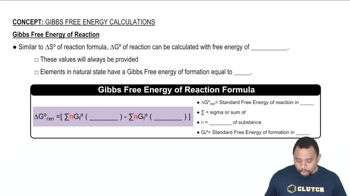
Gibbs Free Energy (ΔG)
Gibbs Free Energy (ΔG) is a thermodynamic potential that measures the maximum reversible work obtainable from a thermodynamic system at constant temperature and pressure. It is a crucial factor in determining the spontaneity of a reaction; a negative ΔG indicates a spontaneous process, while a positive ΔG suggests non-spontaneity. Understanding how ΔG changes with temperature is essential for predicting reaction behavior.
Recommended video:
Guided course
Gibbs Free Energy of Reactions
Temperature Dependence of ΔG
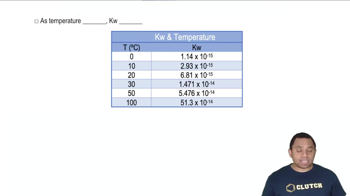
The temperature dependence of Gibbs Free Energy is described by the equation ΔG = ΔH - TΔS, where ΔH is the change in enthalpy, T is the temperature in Kelvin, and ΔS is the change in entropy. As temperature increases, the TΔS term becomes more significant, potentially affecting the overall value of ΔG. This relationship is vital for understanding how temperature influences reaction spontaneity.
Recommended video:
Guided course
Kw Temperature Dependence
Entropy (ΔS)
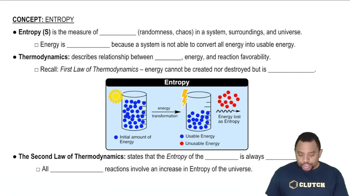
Entropy (ΔS) is a measure of the disorder or randomness in a system. In chemical reactions, an increase in entropy typically favors spontaneity, as systems tend to evolve towards greater disorder. When analyzing the effect of temperature on ΔG, the sign and magnitude of ΔS play a critical role, as they determine how much the entropy change will influence the Gibbs Free Energy at different temperatures.
Recommended video:
Guided course
Entropy in Thermodynamics
Related Practice
Textbook Question
Textbook Question
Consider the following reaction between oxides of nitrogen: NO2(g) + N2O(g) → 3 NO(g) (c) Calculate ΔG at 1000 K. Is the reaction spontaneous under standard conditions at this temperature?
Textbook Question
(a) Using data in Appendix C, estimate the temperature at which the free-energy change for the transformation from I2(s) to I2(g) is zero. (b) Use a reference source, such as Web Elements (www.webelements.com), to find the experimental melting and boiling points of I2. (c) Which of the values in part (b) is closer to the value you obtained in part (a)?
Textbook Question
Consider the following reaction between oxides of nitrogen: NO2(g) + N2O(g) → 3 NO(g) (a) Use data in Appendix C to predict how ΔG for the reaction varies with increasing temperature.
