Consider the following reaction between oxides of nitrogen: NO2(g) + N2O(g) → 3 NO(g) (b) Calculate ΔG at 800 K, assuming that ΔH° and ΔS° do not change with temperature. Under standard conditions is the reaction spontaneous at 800 K?
For a particular reaction, ΔH = -32 kJ and ΔS = -98 J>K. Assume that ΔH and ΔS do not vary with temperature. (a) At what temperature will the reaction have ΔG = 0? (b) If T is increased from that in part (a), will the reaction be spontaneous or nonspontaneous?
Verified step by step guidanceKey Concepts
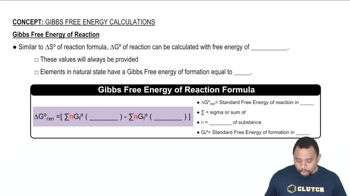
Gibbs Free Energy (ΔG)
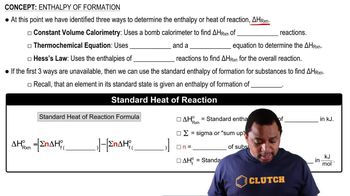
Enthalpy (ΔH)
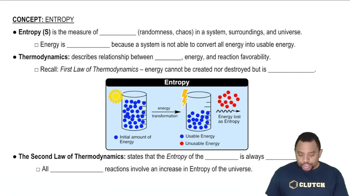
Entropy (ΔS)
From the values given for ΔH° and ΔS°, calculate ΔG° for each of the following reactions at 298 K. If the reaction is not spontaneous under standard conditions at 298 K, at what temperature (if any) would the reaction become spontaneous?
a. 2 PbS(s) + 3 O2(g) → 2 PbO(s) + 2 SO2(g) ΔH° = −844 kJ; ΔS° = −165 J/K
b. 2 POCl3(g) → 2 PCl3(g) + O2(g) ΔH° = 572 kJ; ΔS° = 179 J/K
Reactions in which a substance decomposes by losing CO are called decarbonylation reactions. The decarbonylation of acetic acid proceeds according to: CH3COOH(l) → CH3OH(g) + CO(g) By using data from Appendix C, calculate the minimum temperature at which this process will be spontaneous under standard conditions. Assume that ΔH° and ΔS° do not vary with temperature.
Consider the following reaction between oxides of nitrogen: NO2(g) + N2O(g) → 3 NO(g) (a) Use data in Appendix C to predict how ΔG for the reaction varies with increasing temperature.
A certain constant-pressure reaction is barely nonspontaneous at 45 °C. The entropy change for the reaction is 72 J/K. Estimate ΔH.
