

A system goes from state 1 to state 2 and back to state 1. (c) Suppose the changes in state are reversible processes. Is the work done by the system upon going from state 1 to state 2 the same or different as compared to that upon going from state 2 back to state 1?
(b) Without further information, can you conclude whether the amount of heat transferred to the system as it goes from state 1 to state 2 is the same or different compared to that upon going from state 2 back to state 1?
Verified step by step guidanceKey Concepts
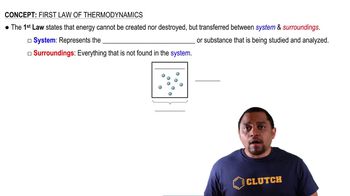
First Law of Thermodynamics
Path Dependence of Heat Transfer
State Functions
Consider a process in which an ideal gas changes from state 1 to state 2 in such a way that its temperature changes from 300 K to 200 K. (b) Is this process isothermal?
Indicate whether each statement is true or false. (a) ΔS is a state function. (b) If a system undergoes a reversible change, the entropy of the universe increases. (c) If a system undergoes a reversible process, the change in entropy of the system is exactly matched by an equal and opposite change in the entropy of the surroundings. (d) If a system undergoes a reversible process, the entropy change of the system must be zero.
Consider a process in which an ideal gas changes from state 1 to state 2 in such a way that its temperature changes from 300 K to 200 K. (a) Does the temperature change depend on whether the process is reversible or irreversible?
Consider a process in which an ideal gas changes from state 1 to state 2 in such a way that its temperature changes from 300 K to 200 K. (c) Does the change in the internal energy, ΔE, depend on the particular pathway taken to carry out this change of state?
