Rainwater is acidic because CO21g2 dissolves in the water, creating carbonic acid, H2CO3. If the rainwater is too acidic, it will react with limestone and seashells (which are principally made of calcium carbonate, CaCO3). Calculate the concentrations of carbonic acid, bicarbonate ion 1HCO3-2 and carbonate ion 1CO32 - 2 that are in a raindrop that has a pH of 5.60, assuming that the sum of all three species in the raindrop is 1.0 * 10-5 M.
Ch.17 - Additional Aspects of Aqueous Equilibria
Brown14th EditionChemistry: The Central ScienceISBN: 9780134414232Not the one you use?Change textbook
Chapter 17, Problem 86
The acid–base indicator bromcresol green is a weak acid. The yellow acid and blue base forms of the indicator are present in equal concentrations in a solution when the pH is 4.68. What is the pKa for bromcresol green?
Verified step by step guidance1
Identify that the problem involves an acid-base indicator, which is a weak acid, and its pKa value needs to be determined.
Recall that when the concentrations of the acid form and the base form of an indicator are equal, the pH of the solution is equal to the pKa of the indicator.
Understand that the given pH value of 4.68 is the point at which the concentrations of the yellow acid form and the blue base form of bromcresol green are equal.
Conclude that the pKa of bromcresol green is equal to the pH at which the concentrations of the two forms are equal, which is 4.68.
Therefore, the pKa for bromcresol green is 4.68.

Verified video answer for a similar problem:
This video solution was recommended by our tutors as helpful for the problem above.
Video duration:
2mWas this helpful?
Key Concepts
Here are the essential concepts you must grasp in order to answer the question correctly.
Acid-Base Indicators
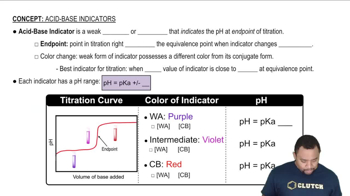
Acid-base indicators are substances that change color in response to changes in pH. They are typically weak acids or bases that exhibit different colors in their protonated and deprotonated forms. For example, bromcresol green appears yellow in acidic conditions and blue in basic conditions, making it useful for determining the pH of a solution.
Recommended video:
Guided course
Acid-Base Indicators
pKa and pH Relationship
The pKa of an acid is the negative logarithm of its acid dissociation constant (Ka) and represents the pH at which the concentrations of the protonated and deprotonated forms of the acid are equal. When the pH of a solution equals the pKa, the acid and its conjugate base are present in equal amounts, which is crucial for understanding the behavior of weak acids and bases in solution.
Recommended video:
Guided course
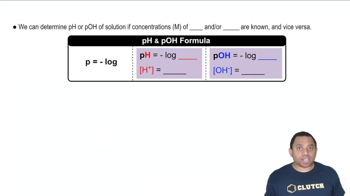
pH and pOH Calculations
Henderson-Hasselbalch Equation
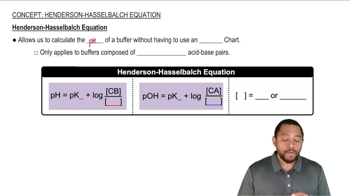
The Henderson-Hasselbalch equation relates the pH of a solution to the pKa of an acid and the ratio of the concentrations of its deprotonated and protonated forms. It is expressed as pH = pKa + log([A-]/[HA]). This equation is particularly useful for calculating the pKa when the pH and concentrations of the acid and base forms are known, as in the case of bromcresol green.
Recommended video:
Guided course
Henderson-Hasselbalch Equation
Related Practice
Textbook Question
Textbook Question
Derive an equation similar to the Henderson–Hasselbalch equation relating the pOH of a buffer to the pKb of its base component.
Textbook Question
Two buffers are prepared by adding an equal number of moles of formic acid (HCOOH) and sodium formate (HCOONa) to enough water to make 1.00 L of solution. Buffer A is prepared using 1.00 mol each of formic acid and sodium formate. Buffer B is prepared by using 0.010 mol of each. (b) Which buffer will have the greater buffer capacity?
1
views
