
Textbook Question
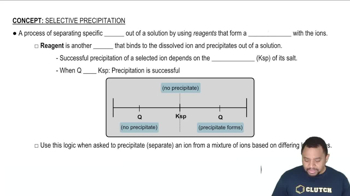
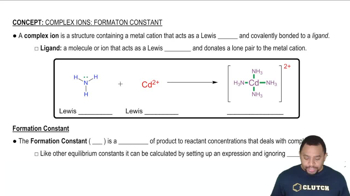
Suggest how the cations in each of the following solution mixtures can be separated: (c) Pb2 + and Al3 +.
1
views
 Verified step by step guidance
 01:53
01:53
 02:20
02:20 04:50
04:50Suggest how the cations in each of the following solution mixtures can be separated: (c) Pb2 + and Al3 +.
(b) What is the most significant difference between the sulfides precipitated in group 2 and those precipitated in group 3?
In the course of various qualitative analysis procedures, the following mixtures are encountered: (c) Mg2+ and K+ (d) Ag+ and Mn2+. Suggest how each mixture might be separated.
A solution containing several metal ions is treated with dilute HCl; no precipitate forms. The pH is adjusted to about 1, and H2S is bubbled through. Again, no precipitate forms. The pH of the solution is then adjusted to about 8. Again, H2S is bubbled through. This time a precipitate forms. The filtrate from this solution is treated with (NH4)2HPO4. No precipitate forms. Which of these metal cations are either possibly present or definitely absent: Al3+, Na+, Ag+, Mg2+?