Indicate whether each of the following statements is correct or incorrect. (c) Conjugate acids of weak bases produce more acidic solutions than conjugate acids of strong bases.
Ch.16 - Acid-Base Equilibria
Brown14th EditionChemistry: The Central ScienceISBN: 9780134414232Not the one you use?Change textbook
Chapter 16, Problem 99
Indicate whether each of the following statements is correct or incorrect. (e) The percent ionization of a weak acid in water increases as the concentration of the acid decreases.
Verified step by step guidance1
Understand the concept of percent ionization: Percent ionization refers to the fraction of acid molecules that dissociate into ions in solution, expressed as a percentage.
Recall the behavior of weak acids: Weak acids do not completely dissociate in water. The degree of ionization depends on the acid's strength and concentration.
Consider the effect of concentration on ionization: As the concentration of a weak acid decreases, the equilibrium shifts to favor more ionization according to Le Chatelier's principle.
Apply Le Chatelier's principle: When the concentration of the acid decreases, the system compensates by increasing the ionization to maintain equilibrium, thus increasing the percent ionization.
Conclude the statement's correctness: Based on the principles of equilibrium and ionization, the statement that the percent ionization of a weak acid increases as the concentration decreases is correct.
Key Concepts
Here are the essential concepts you must grasp in order to answer the question correctly.
Weak Acids and Ionization
Weak acids are substances that partially dissociate in water to produce hydrogen ions (H+) and their conjugate base. The degree of ionization is a measure of how much of the acid has dissociated into ions. Unlike strong acids, which fully dissociate, weak acids establish an equilibrium between the undissociated acid and the ions produced.
Recommended video:
Guided course
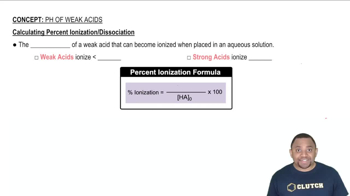
Calculating Percent Ionization of Weak Acids
Percent Ionization
Percent ionization is defined as the ratio of the concentration of ionized acid to the initial concentration of the acid, multiplied by 100. It provides a way to express the strength of a weak acid in terms of how much of it has dissociated into ions. This value can change with varying concentrations of the acid.
Recommended video:
Guided course
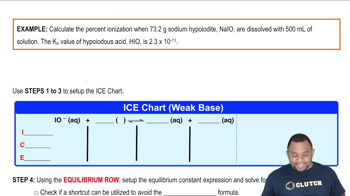
Percent Ionization Example
Effect of Concentration on Ionization
For weak acids, as the concentration of the acid decreases, the percent ionization increases. This occurs because a lower concentration leads to a smaller amount of undissociated acid, allowing a greater proportion of the acid to ionize. This relationship is a key characteristic of weak acid behavior in solution.
Recommended video:
Guided course
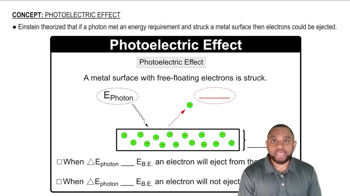
Photoelectric Effect
Related Practice
Textbook Question
1
views
Textbook Question
Identify the Lewis acid and Lewis base in each of the following reactions:
(a) HNO2(aq) + OH-(aq) ⇌ NO2-(aq) + H2O(l)
(b) FeBr3(s) + Br-(aq) ⇌ FeBr4-(aq)
(c) Zn2+(aq) + 4 NH3(aq) ⇌ Zn(NH3)42+(aq)
(d) SO2(g) + H2O(l) ⇌ H2SO3(aq)
Textbook Question
A solution is made by adding 0.300 g Ca1OH221s2, 50.0 mL of 1.40 M HNO3, and enough water to make a final volume of 75.0 mL. Assuming that all of the solid dissolves, what is the pH of the final solution?
Textbook Question
Which member of each pair produces the more acidic aqueous solution: (a) ZnBr2 or CdCl2 (b) CuCl or Cu(NO3)2 (c) Ca(NO3)2 or NiBr2
Textbook Question
Indicate whether each of the following statements is correct or incorrect. (d) K+ ion is acidic in water because it causes hydrating water molecules to become more acidic.