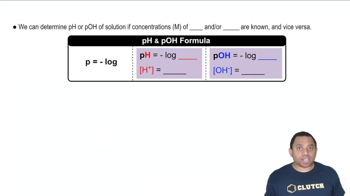
Write the expression for the ion product constant for water, Kw.
Ch.16 - Acid-Base Equilibria
Brown14th EditionChemistry: The Central ScienceISBN: 9780134414232Not the one you use?Change textbook
Chapter 16, Problem 30b
Calculate 3OH-4 for each of the following solutions, and indicate whether the solution is acidic, basic, or neutral: (b) 3H+4 = 2.5 * 10-10 M
Verified step by step guidance1
Identify the given concentration: \([H^+] = 2.5 \times 10^{-10} \text{ M}\).
Use the relationship between \([H^+]\) and \([OH^-]\) in water: \([H^+][OH^-] = 1.0 \times 10^{-14}\).
Rearrange the equation to solve for \([OH^-]\): \([OH^-] = \frac{1.0 \times 10^{-14}}{[H^+]}\).
Substitute the given \([H^+]\) value into the equation to find \([OH^-]\).
Determine if the solution is acidic, basic, or neutral by comparing \([H^+]\) and \([OH^-]\): if \([H^+] > [OH^-]\), it's acidic; if \([H^+] < [OH^-]\), it's basic; if \([H^+] = [OH^-]\), it's neutral.

Verified video answer for a similar problem:
This video solution was recommended by our tutors as helpful for the problem above.
Video duration:
2mWas this helpful?
Key Concepts
Here are the essential concepts you must grasp in order to answer the question correctly.
pH and pOH
pH is a measure of the hydrogen ion concentration in a solution, while pOH measures the hydroxide ion concentration. The relationship between pH and pOH is defined by the equation pH + pOH = 14 at 25°C. Understanding this relationship is crucial for determining the acidity or basicity of a solution.
Recommended video:
Guided course
pH and pOH Calculations
Acidic, Basic, and Neutral Solutions
A solution is considered acidic if its pH is less than 7, basic if its pH is greater than 7, and neutral if its pH is exactly 7. The concentration of hydrogen ions (H+) and hydroxide ions (OH-) determines these classifications. For example, a higher concentration of H+ indicates acidity, while a higher concentration of OH- indicates basicity.
Recommended video:
Guided course
Balancing Basic Redox Reactions
Calculating pOH from H+ Concentration
To find the pOH from the concentration of hydrogen ions (H+), first calculate the pH using the formula pH = -log[H+]. Then, use the relationship pOH = 14 - pH to find the pOH. This calculation is essential for determining the nature of the solution based on its hydroxide ion concentration.
Recommended video:
Guided course
pH and pOH Calculations
Related Practice
Textbook Question
Textbook Question
Calculate [H+] for each of the following solutions, and indicate whether the solution is acidic, basic, or neutral: (a) [OH-] = 0.00045 M (b) [OH-] = 8.8 × 10⁻⁹ M (c) a solution in which [OH-] is 100 times greater than [H+].
Textbook Question
Calculate 3OH-4 for each of the following solutions, and indicate whether the solution is acidic, basic, or neutral: (a) 3H+4 = 0.0505 M
Textbook Question
Calculate 3OH-4 for each of the following solutions, and indicate whether the solution is acidic, basic, or neutral: (c) a solution in which 3H+4 is 1000 times greater than 3OH-4.
Textbook Question
Which of the following solutions is the most acidic? (a) 0.2 M Ba(OH)2, (b) 0.2 M H2SO3, (c) 1.0 M glucose 1C6H12O6).
Textbook Question
Deuterium oxide 1D2O, where D is deuterium, the hydrogen-2 isotope) has an ion-product constant, Kw, of 8.9 * 10-16 at 20 °C. Calculate 3D+4 and 3OD-4 for pure (neutral) D2O at this temperature.