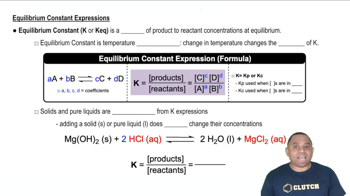
The following equilibria were measured at 823 K: CoO(s) + H2(g) ⇌ Co(s) + H2O(g) Kc = 67 H2(g) + CO2(g) ⇌ CO(g) + H2O(g) Kc = 0.14 (a) Use these equilibria to calculate the equilibrium constant, Kc, for the reaction CoO(s) + CO(g) ⇌ Co(s) + CO2(g) at 823 K.
Consider the reaction IO4- (aq) + 2 H2O (l) ⇌ H4IO6- (aq); Kc = 3.5 * 10^-2. If you start with 25.0 mL of a 0.905 M solution of NaIO4 and then dilute it with water to 500.0 mL, what is the concentration of H4IO6- at equilibrium?
Verified step by step guidanceKey Concepts
Equilibrium Constant (Kc)
Dilution and Concentration Calculations
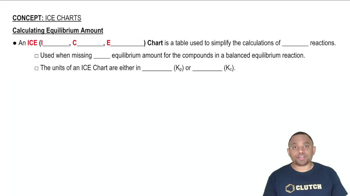
ICE Table (Initial, Change, Equilibrium)
The following equilibria were measured at 823 K: CoO(s) + H2(g) ⇌ Co(s) + H2O(g) Kc = 67 H2(g) + CO2(g) ⇌ CO(g) + H2O(g) Kc = 0.14 (d) If the reaction vessel from part (c) is heated to 823 K and allowed to come to equilibrium, how much CoO(s) remains?
At a temperature of 700 K, the forward and reverse rate constants for the reaction 2 HI(g) ⇌ H2(g) + I2(g) are kf = 1.8×10⁻³⁰ M−1s−1 and kr = 0.063 M−1s−1.
(a) What is the value of the equilibrium constant Kc at 700 K?
(b) Is the forward reaction endothermic or exothermic if the rate constants for the same reaction have values of kf = 0.097M−1s−1 and kr = 2.6 M−1s−1 at 800 K?
Consider the hypothetical reaction A(𝑔) + 2 B(𝑔) ⇌ 2 C(𝑔), for which 𝐾𝑐 = 0.25 at a certain temperature. A 1.00-L reaction vessel is loaded with 1.00 mol of compound C, which is allowed to reach equilibrium. Let the variable x represent the number of mol/L of compound A present at equilibrium.
(d) The equation from part (c) is a cubic equation (one that has the form ax3 + bx2 + cx + d = 0). In general, cubic equations cannot be solved in closed form. However, you can estimate the solution by plotting the cubic equation in the allowed range of x that you specified in part (b). The point at which the cubic equation crosses the x-axis is the solution.
(e) From the plot in part (d), estimate the equilibrium concentrations of A, B, and C. (Hint: You can check the accuracy of your answer by substituting these concentrations into the equilibrium expression.)