The equilibrium constant constant πΎπ for C(π ) + CO2(π) β 2 CO(π) is 1.9 at 1000 K and 0.133 at 298 K. (a) If excess C is allowed to react with 25.0 g of CO2 in a 3.00-L vessel at 1000 K, how many grams of CO are produced? (b) If excess C is allowed to react with 25.0 g of CO2 in a 3.00-L vessel at 1000 K, how many grams of C are consumed?
At 700 K, the equilibrium constant for the reaction CCl4(π) β C(π ) + 2 Cl2(π) is πΎπ = 0.76. A flask is charged with 2.00 atm of CCl4, which then reaches equilibrium at 700 K. (a) What fraction of the CCl4 is converted into C and Cl2?
Verified step by step guidance
Verified video answer for a similar problem:
Key Concepts
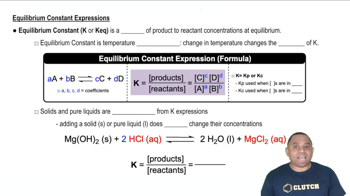
Equilibrium Constant (Kp)
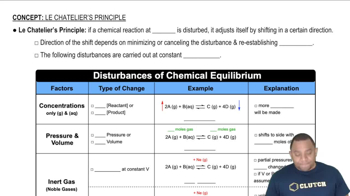
Le Chatelier's Principle
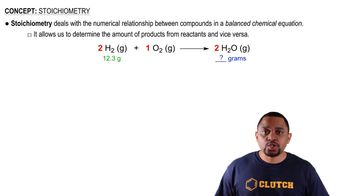
Stoichiometry of the Reaction
Consider the hypothetical reaction A(π) + 2 B(π) β 2 C(π), for which πΎπ = 0.25 at a certain temperature. A 1.00-L reaction vessel is loaded with 1.00 mol of compound C, which is allowed to reach equilibrium. Let the variable x represent the number of mol/L of compound A present at equilibrium.
(d) The equation from part (c) is a cubic equation (one that has the form ax3 + bx2 + cx + d = 0). In general, cubic equations cannot be solved in closed form. However, you can estimate the solution by plotting the cubic equation in the allowed range of x that you specified in part (b). The point at which the cubic equation crosses the x-axis is the solution.
(e) From the plot in part (d), estimate the equilibrium concentrations of A, B, and C. (Hint: You can check the accuracy of your answer by substituting these concentrations into the equilibrium expression.)
At 700 K, the equilibrium constant for the reaction CCl4(π) β C(π ) + 2 Cl2(π) is πΎπ = 0.76. A flask is charged with 2.00 atm of CCl4, which then reaches equilibrium at 700 K. (b) What are the partial pressures of CCl4 and Cl2 at equilibrium?